12 March 2013

That Little Fat Man (Tombstone Tuesday)

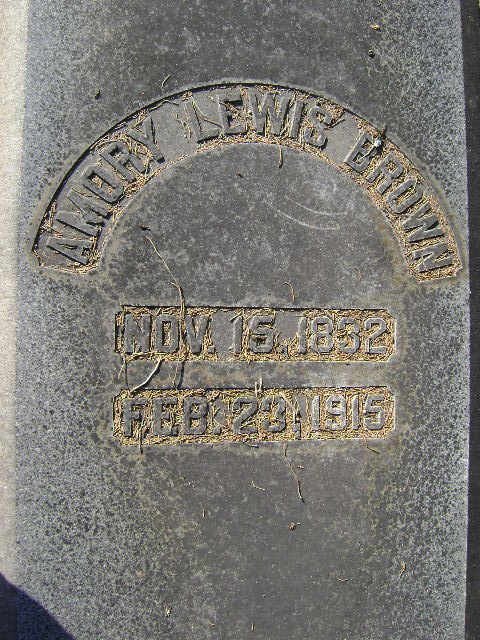
Amory Lewis Brown
(Nov 15, 1832 - Feb 23, 1915)
Photo by James Allen
..."with a hole in his head, done at Chancellorsville, is Amory L. Brown, and as clever as he is plump" is a description given in 1873 of an employee of the Great Dry Goods Emporium of Middle Georgia.1

We can learn a lot more about A. L. Brown's Confederate service by reading his pension applications at Ancestry, as well as his service record file at Fold3. Amory applied for an Indigent Pension in the years 1903 through 1907 (at least). The paperwork for 1903 states he was born 1834 in Burke County, Georgia, and remained a resident of the state of Georgia from that point on. Amory enlisted 4 March 1862 and served in Company H of the 45th Georgia regiment. He remained a soldier in said unit until late March of 1865, when he was taken as a prisoner of war at Petersburg and sent to Fort Delaware. He was not released until June of that year -- a couple of months after the war was supposedly over.

After the war, Amory supported himself as a salesman in a dry goods store. But by the late 1890's (if not before) was unable to do so. He states:
I suffer all the time from Rheumatism - and have for years - I have a wound in my head received during the war. Leaves a sunken place above my eyes just below the top of my forehead, and it causes some great pain - Headaches - Vertigo - [awful?] [?] for all work. Cant get employment on account of this head attack and Rheumatism.
The application also included an affidavit from physicians Gewinner and Gostin:
On account of frequent attacks of Rheumatism, coupled with his age (he is now 68 yrs of age) he is utterly unable to make a living. At the battle of Chancellorsville, Va. he was shot in the head leaving a depression in the skull and this at times causes him considerable trouble.
Amory's Confederate service record (at Fold3) describes him as having a light complexion, dark hair, blue eyes, and a height of 5' 5". It also shows Lt. Brown in a hospital at Richmond, Virginia in May of 1863. He was transferred to Macon, Georgia for 30 days.

What amazes me is Lt. Amory L. Brown returned to his unit and kept pressing forward!

Recap: Amory enlists 4 March 1862. A little more than a year later he is shot in the head during the Battle of Chancellorsville, Virginia and taken to a Richmond hospital. He is given a transfer to Macon, Georgia for 30 days. Amory then returns to his unit and continues to serve until he is captured as a prisoner of war in Petersburg, VA late March 1865 and taken to Fort Delaware. He is not released until June, so he cannot even begin to make his way home until two months after Lee's surrender.

Wow.


Footnote:
1. "The Great Dry Goods Emporium of Middle Georgia." Macon Weekly Telegraph (Georgia), 25 March 1873, pg. 7; digital image, GenealogyBank, (http://www.genealogybank.com : accessed March 2013), Historical Newspapers.
04 March 2013

Here Lies a Musician

Photo by James Allen
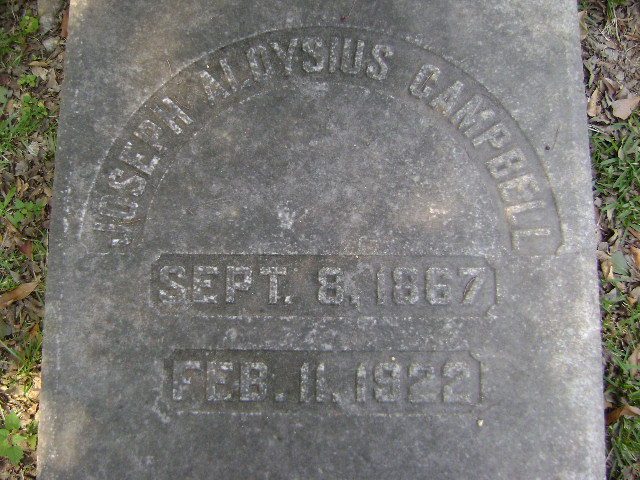
DEATHS AND FUNERALS: JOE CAMPBELL
The funeral of Joe Campbell was held yesterday afternoon at 4 o'clock at St. Joseph's Catholic church, the service being conducted by Rev. Father Wilkinson.

The following were the pallbearers: F. A. Huthnance, W. P. Bennett, John Harrison, Dennis Ca[ssidy?], E. E. Pound, R. E. Cason, M. J. Redmond and Dr. W. D. Wells.

Mr. Campbell was a musician and was prominent in Catholic church and society circles. [Macon Telegraph (Georgia), 13 February 1922, pg. 7 -- Viewed online at GenealogyBank.]


02 March 2013

Obituaries for Mother and Daughter Conner

Photo by James Allen
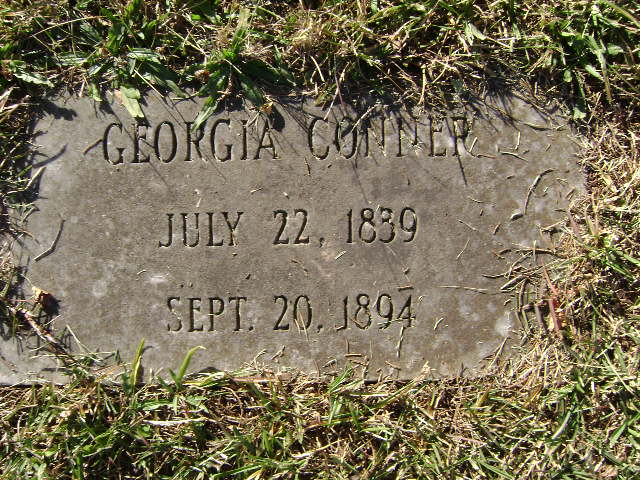
MISS CONNER BURIED

One of Macon's Noblest Women Laid to Rest in Rose Hill.


The funeral services of Miss Georgia Conner, who died at the family residence on Walnut street Thursday evening, were conducted at Christ Episcopal church yesterday afternoon and the remains were laid to rest in Rose Hill cemetery.

Miss Conner's death has cast a gloom over the entire community and bowed the hearts of loving relatives and many dear friends with grief. She was one of those gentle women that help to purify and make better mankind, and a nobler, truer Christian woman never lived. Her life was a beautiful one, and her example is worthy of emulation. She died as she had lived, peacefully and gently, with strong faith in him who doeth all things well. This community suffers an irreparable loss in the death of Miss Conner. Heaven is richer.

Miss Conner was a sister of Messrs. Granville C., Thomas U., Fred and Henry C. Conner and of Mrs. W. A. Hopson.

The funeral was largely attended and the many handsome floral designs that covered the casket lid were evidences of the high esteem in which she was held. [Macon Telegraph (Georgia), 22 September 1894, pg. 6 -- Viewed online at the Digital Library of Georgia's Historic Newspapers project.]

Photo by James Allen
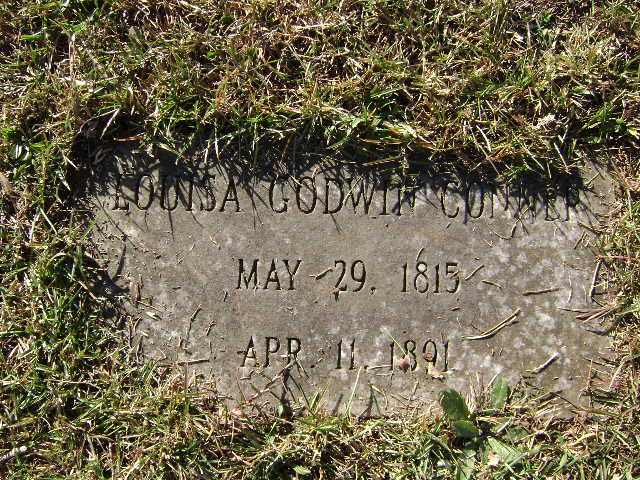
MRS. CONNER PASSES AWAY.

The Mother of Alderman Conner Closes a Long and Useful Life.

Mrs. Louisa Conner, one of Macon's oldest and best-known residents, departed this life at the residence of her daughter, Mrs. V. A. Hopson, on Walnut street, at 2 o'clock yesterday afternoon.

This announcement will sadden the hearts of the many who knew this estimable woman. She had lived in Macon for more than fifty years, but was a native of Virginia. Although she had reached the venerable age of 76 years, time had dealt so leniently with her that she was more handsome than most ladies thirty years younger.

She leaves seven children: Granville C. Conner, a member of the board of aldermen; T. V. Conner, a merchandise broker; Frank H., David B. and Frederick G. Conner, who are also in business, and two daughters, Mrs. Virginia A. Hopson and Miss Georgia Conner.

The funeral will be held on Sunday morning, from Christ church. [Macon Telegraph (Georgia), 11 April 1891, pg. 2 -- Viewed online at GenealogyBank.]

17 February 2013

Who the Victims Are (Terrific Explosion Finale)

[The beginning is here.]

"Who the Victims Are.
Photo by James Allen
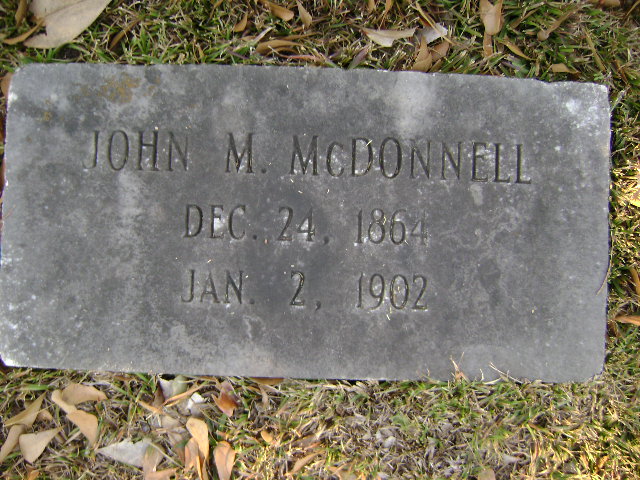
Mr. John McDonnell, who was killed, leaves a widow and a babe 11 months old. He has resided in Macon about ten years. He has a number of relatives in Knoxville, Tenn., and a brother who is a machinist in the navy yard at Washington, D. C. He has a sister at Knoxville. Two relatives will be here from Knoxville, and the brother will come from Washington, so that the funeral cannot be held until Saturday morning. Mr. McDonnell's father cannot come, because he is quite ill. Deceased was a member of the International Association of Machinists and of the Hibernian Benevolent Society. He was 36 years old, and in full bloom of manhood. Few men had made so many friends in Macon in so short a time. His exemplary conduct was always an inspiration to others. He is a brother-in-law of Messrs. James E. Reid, T. C. Hickey and W. M. Dewberry. His residence is at 2001 Fourth street.

Photo by James Allen
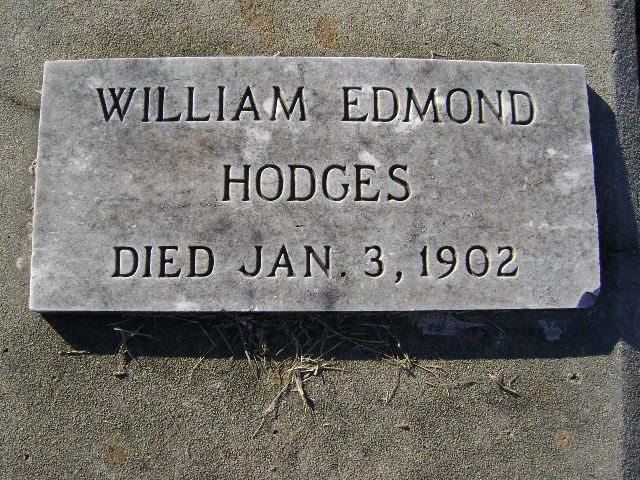
Mr. Edmond William Hodges was 50 years old, and he leaves a widow and four children, Willis, Earle, Frank ad Martha. He resided at 117 Bellevue avenue, Huguenin Heights, and the funeral will occur from there today, as per funeral notice in another column. He has spent the greater part of his life in the service of railroads at Macon, going into the shops at Macon years ago at the same time that Sheriff Westco[l?]t entered to learn his trade. Deceased was a brother of Messrs. Robert and Ollie Hodges, and enjoyed the confidence and esteem of all who knew him.

Uriah Cornelius, the negro who was on the engine when the explosion occurred, and who was blown to pieces, was a fireman. He will turned over to the colored Knights of Pythias for burial, as he was a member of that order. He came to Macon from some point above Cochran.

Mr. R. L. Willis, who was injured, is thought to be in a fair way to recover. He is an alderman, representing the Fourth ward. His excellent race for that position in the recent municipal election will be recalled by all. He was taken to his home immediately after the accident.

Mr. Henry Fox is one of the oldest employes [sic] in the shops. He is 58 years old. He is highly esteemed by all who know him, and many prayers were offered last night for his recovery.

Mr. W. M. Wilson had just moved to Macon from Jones county, and accepted a position with the road the day before the accident. He has a wife and children in East Macon. He is a brother to Police Officer Wilson.

Mr. James O'Neal is a young man hardly 21 years old. He has a devoted mother residing in East Macon. His sister died a short time ago.

Mr. Ed Hambrick resides in East Macon. He was one of the carpenters on the shed near the engine. It is thought he will pull through without difficulty." [Macon Telegraph (Georgia), 3 January 1902, Pg. 5 -- Viewed online at GenealogyBank.]

All Posts in Series:
- Terrific Explosion Followed by Death
- I Cannot Live; You Cannot Do Anything for Me
- A Leg Bone was Found Just Over the Fence
- The Deceased Came to Their Death from the Explosion of an Engine Boiler
- Both Men were Blown Away, and Killed Instantly
- Who the Victims Are

16 February 2013

Both Men were Blown Away, and Killed Instantly (Terrific Explosion, Pt. 5)

[Part 1 is here.]

"Theories Advanced.
The testimony of the foreman showed that at 7 o'clock he had noticed two gages of water in the boiler and twenty pounds of steam. Thirty-five minutes later the explosion occurred. It was thought to be impossible that the water supply could have diminished to the danger line within that time or that the steam could have been run up to the 160 pounds pressure point.

Several engineers who went out to the scene of the wreck and examined the pieces of the boiler give as their opinion that the metal had been "cooked," and that steam did not cause the explosion. "I have worked on an engine twenty-five years," said one, "and I never saw steam shatter a boiler in that manner. I never saw gas fail to shatter one in that way. What I mean by gas is that peculiar kind of force that is generated when cold water is poured on red hot metal. The steam presses against all side of the boiler at one time, and with equal force in all directions. It bursts out at the weakest place, and may blow a hole or crack that boiler and all the water and steam will rush out; but when you see the boiler shivered and blown to atoms, it is a pretty good indication that the contact of cold water and red hot iron had something to do with it."

The railroad authorities combat this theory with the statement that there is a soft metal plug in all locomotives hollers, and when the water gets below a certain point this plug is exposed to the fire, melting immediately and preventing an explosion. Boiler-makers say, however, that these plugs often become encrusted with dirt and rust and cannot be melted out. The only men who could throw any satisfactory light on the subject are dead. They are the negro, Uriah Cornelius and Mr. McDonnell.

Others who undertake to arrive at a cause reason it out this way:

That is was necessary for the negro to get up to 160 pounds of steam before Mr. McDonnell could see the pop valve at the proper point, and in trying to accomplish this in the quickest possible time, he forgot to keep up his water supply, and that the less water he kept in the boiler the faster he would accumulate steam; that with the blower on, the two gages of water were quickly consumed, and when he looked and saw that the supply was low he turned in more water, as he had done perhaps thousands of times before without serious results. That the sheets in the boiler had already become heated and the contact of the cool water did the work. Both men were blown away, and killed instantly. It is claimed that this is a more plausible theory than the one that Mr. McDonnell's pop valve refused to work and caused the steam to burst the boiler.

However, the matter is simply one for conjecture, and men may always differ about it.

Mr. McDonnell was putting in a new pop valve, because on the day before the old one refused to work. It was necessary to set the new valve, and 160 pounds of steam was needed. Then, after it was set, the valve would open whenever 160 pounds of steam was accumulated, and there would be no danger of a steam explosion.

Condition of the Boiler.
After the explosion it was found that the top of the boiler was turned back at the front end, although at that point 150 bolts had held down the top." [Macon Telegraph (Georgia), 3 January 1902, Pgs. 1 & 5]

The finale is next with "Who the Victims Are."

15 February 2013

The Deceased Came to Their Death from the Explosion of an Engine Boiler (Terrific Explosion, Pt. 4)

[Part 1 is here.]

Early 1920's Ambulance.
Image from Library of Congress
"Ambulance Kept Busy
As soon as the news of the explosion reached the city authorities, Chief Boifeuillet sent the ambulance to the scene. Mayor Smith tendered Superintendent Epperson the use of the police force to keep the crowds of curious people out of the way, the ambulance and patrol wagon, borrowing a driver from the fire department for it, carrying the wounded to the hospital, and also the fire department wagons for the same purpose. In this way there was no delay in conveying the wounded men to the hospital. The ambulance purchased by the city has paid for itself dozens of times, it is claimed, and the fact that it is given by the city to hospital use is greatly appreciated by the general public.

Coroner's Investigations.
Coroner Davis arrived on the scene soon after he was notified, and he summoned a separate jury for each of the three dead men. The bodies had been taken to Wood's undertaking parlors, and the inquests were held there.

The evidence developed in the cases was identical. It threw no light on the cause of the accident, and fixed no responsibility, the verdict being: "We, the jury, find that the deceased came to their death from the explosion of an engine boiler. The cause of the explosion we cannot ascertain." [Macon Telegraph (Georgia), 3 January 1902, pg. 1 -- Viewed online at GenealogyBank.]

Next up: "Theories Advanced" and "Condition of the Boiler."

14 February 2013

A Leg Bone was Found Just Over the Fence (Terrific Explosion, Pt. 3)

[Part 1 is here.]

"LIKE AN EARTHQUAKE.

The Explosion Was Heard Seven Miles from the City -- Glasses Broken.

The explosion occurred at 7:35, according to the timepiece of the railroad men. Its effect on the surrounding country was very much like that of an earthquake. Many people explained it that way. Window glasses were broken, trees were seen to vibrate, plastering cracked, and general alarm was caused.

People who came in from the country during the afternoon inquired to find out what had happened. They declared that the shock could be distinctly felt seven miles out.

Harrowing Scenes Followed.
The news of the tragedy spread like wildfire throughout the city. Those familiar with the location of the round house noticed immediately that a great cloud of smoke and steam hovered over it, and many guessed that an explosion had occurred.

Every man in the employ of the shops has a family, or large family connections, and it required but a few moments for hundreds of these to gather about the gates of the shop yards, and plead for admission and for information. They were quickly joined by several thousand other people seeking information. But nothing definite could be learned. And for an hour or more it was impossible to tell how many men employed in the yards escaped injury, or whether any of them had.

Pieces of the wrecked engine were scattered all over the adjacent territory, and here and there a bone or a particle of brains or flesh added to the gruesomeness of the situation. A leg bone was found just over the fence, and a piece of the engine weighing upward of three thousand pounds was found 150 feet from where the explosion occurred. A negro found a handful of brains 100 yards away. A piece of the boiler about the size of a man's hand was picked up at the brewery, about three hundred yards distant. As these things came to light, the weeping of the mothers and sisters, wives and children, fathers, sons and brothers, who were in great mental distress because they had either heard the sad news from their loved ones or else because they could not get satisfactory information, beggars description." [Macon Telegraph (Georgia), 3 January 1902, Pg. 1 -- Viewed online at GenealogyBank.]

Next up: "Ambulance Kept Busy" and "Coroner's Investigations."

13 February 2013

I Cannot Live; You Cannot Do Anything for Me (Terrific Explosion, Pt. 2)

[Part 1 is here.]

"Location of the Injured Men.
The engine was standing over a pit in the portion of the yard where the circular sheds forming the round house fail to meet. Two long tracks enter there from the yards, and there are four of the pits in the open space.

The engine which blew up was in one of these and two pits further to the right, looking toward the swamp, Mr. R. L. Willis was at work under an engine. There was another engine over the pit and between him and the exploding engine. The boiling water and deadly steam broke by the intervening engine, and reached Mr. Willis, burning his arms and stomach. His face was also scalded, and his eyeglasses were blown away. They have not been found. They were all that saved Mr. Willis from from the loss of both of his eyes, for the hot water burned deeply above and below each eye.

Mr. Willis' assistant was James O'Neal, who was standing just outside of the pit in which Mr. Willis was at work. The concussion forced him against the engine and the debris piled on him. He was taken out in such condition that many supposed he was dead. That he was able to breathe was not known to his associates until some time afterward.

Mr. Henry Fox was inspecting an engine near by, and was struck by the flying debris. When taken out he said: "I cannot live; you cannot do anything for me. Go and help somebody who needs help."

Mr. Wilson was a carpenter at work on the roof of the circular shed near Mr. Willis. He and those who were assisting him were blown a considerable distance, but if he escapes death those who were with him are thought to be safe."

WHERE THE EXPLOSION OCCURRED

No. 1 is where the engine stood before the explosion occurred.  It is a
pit with two tracks over it, so that when the engine is back on it, men
can get under the engine and work.
No. 2 is the pit in which Mr. Hodges had been at work.  No. 5 is where
Mr. Hodges was found after the explosion.  He was crossing the open
space presumably to attend to some matter in another part of the yard.
No. 3 is the engine under which Mr. Willis had been at work.
No. 4 is the location of the engine that was between Mr. Willis and
the exploding engine.  It was badly wrecked by the explosion, as was
also the engine under which Mr. Willis had been at work.
There are engines on the two blank tracks, but they were not hurt, the
force of the explosion seeming to go toward the right.  The missile
which struck Mr. Hodges, however, went to the left.  It was never
identified, and probably struck a glancing blow and passed on.

[Macon Telegraph (Georgia) 3 January 1902, Pg. 1]

Next up: "Like an Earthquake" and "Harrowing Scenes Followed."

12 February 2013

Terrific Explosion Followed By Death, Pt. 1 (Tombstone Tuesday)

Photo by James Allen
The next several posts will be comprised of a newspaper account of a horrific explosion in a Macon railroad yard. Two men, John McDonnell and Edmond Hodges, were killed instantly and rest in Rose Hill Cemetery. I intend to share all the details, knowing what great interest this should be to many. Railroad yards were places of occupation for numerous ancestors in a myriad of families. Yet the danger of such is not often spoke of.

"TERRIFIC EXPLOSION FOLLOWED BY DEATH

An Awful Catastrophe at the Central Railroad Shops Here Yesterday Morning -- Engine was Blown to Atoms and Two Men were Instantly Killed, One More Died Soon After, and Three are Supposed to be Fatally Injured -- Six Others are Painfully Hurt -- Theories as to the Cause of the Explosion -- Harrowing Scenes when Loving Ones Gathered About the Yards.


The Telegraph's extra yesterday morning told in detail the story of the disaster at the Central of Georgia Railroad Company's shops, and more than one thousand people rushed for the extras as fast as they could be issued from the press.

The explosion was heard for more than seven miles in the country, and the havoc wrought was almost complete.

The dead are:
JOHN MCDONNELL, engine inspector, who was on top of the engine.
URIAH CORNELIUS, a negro who was in the cab assisting Mr. McDonnell.
E. W. HODGES, who was crossing the yard about 100 feet from the engine.

Injured:
J. I. O'NEAL, machinist, comminuted compound fracture right elbow; lacerated wound back of head; brain injury; will die.
R. L. WILLIS, blacksmith, scalded.
HENRY FOX, engine inspector, comminuted fracture both legs below knee; compound fracture right ankle; lacerated over symphis [sic] pubis; condition bad.
E. D. HAMBRICK, carpenter, lacerated wound of face and head.
W. M. WILSON, carpenter, fracture right rib; lung injury; serious.
J. M. MEADOWS, carpenter, lacerated wound right ear; contused right hip and knee; bruised all over.
PETER HAMMOCK, col., scalp wound; contusion of left hip, and right side of head.
WESLEY JOHNSON, colored, cut right side of face; right hip bruised; not serious.
PETER ADAMS, colored laborer, contusion of right shoulder.

All except R. L. Willis and Peter Adams are in hospital.

Mangled Remains.

The body of Mr. McDonnell was broken to pieces. The bone in each leg was broken in several places. The head was cut away so that only a small portion of the rear skull remains. The face was torn off and destroyed. Mr. McDonnell was at work on top of the engine, trying to adjust the pop valve, which had on the day before been found defective. The negro Cornelius was assisting him by firing the engine and getting up steam so the pop could be set to go off at 160 pounds pressure. It was necessary to get up that much steam in order to set the valve at that [?].

Cornelius was broken up as badly as Mr. McDonnell. His head was blown away and his ribs were broken. These two bodies were found nearly a hundred feet from the engine.

Mr. Hodges was crossing the yard in front of the engine and about 100 feet distant when the explosion occurred. He was not killed outright, but some huge object struck him in the side, breaking three ribs, and something else broke his leg. The wound in the side was fatal, and he died soon after being taken up from where he fell." [Macon Telegraph (Georgia), 3 January 1902, pg. 1 - Viewed online at GenealogyBank.]

Next up: "Where the Explosion Occurred" and "Location of the Injured Men."


If you enjoyed this content,
please consider supporting my blog.

02 February 2013

Another Old Citizen Gone to Her Reward

Photo by James Allen
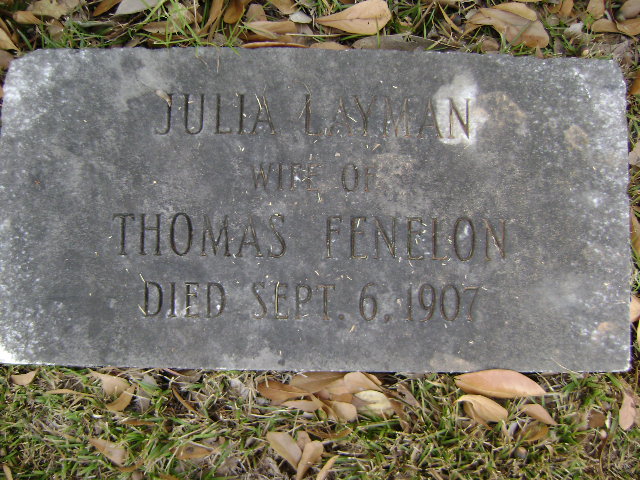
ANOTHER OLD CITIZEN GONE TO HER REWARD

FUNERAL OF MRS. FENELON WILL TAKE PLACE THIS AFTERNOON AT 4 O'CLOCK.


Another old citizen, one of those who grew up with Macon, died yesterday afternoon.

This was Mrs. Julia A. Fenelon, who died at her home, 1921 Third street, in South Macon, after an illness of three months.

She was the widow of Thomas Fenelon, one of Macon's best known railroad men, and was the mother of Mrs. Jas. E. Reed, Mrs. T. C. Hickey, J. T. and J. S. Fenelon, Mrs. J. McDonald and Mrs. W. M. Dewberry.

Mrs. Fenelon lived nearly all her life in Macon. By her good deeds she numbered her friends by the score, and the news of her death will bring sorrow to many households.

The funeral will take place from St. Joseph's Church at 3:30 o'clock, with Father Madden officiating. [Macon Telegraph (Georgia), 7 September 1907, pg. 6 -- viewed online at GenealogyBank.]
Census records suggest Julia was born about 1839 in Virginia. She and her husband Thomas rest in the Eglantine Square section of Rose Hill Cemetery.

28 January 2013

Little Anna Gertrude: Heaven Resounds with Her Hallelujahs of Joy

There is great detail in the stone placed for Anna Gertrude Powers, the ten year old daughter of Virgil and Ann Powers. Anna is represented (a likeness?) and being carried to Heaven by two angels. Notice the finger pointing upward of one of the angels, as well as their tendrils of hair. And notice the cross necklace Anna is wearing. It's a beautiful sculpture. Below the image is a detailed obituary for little Anna, who died of Scarlet Fever.

Anna Gertrude
eldest daughter of Virgil & Ann E. Powers
was born in Washington Co, April 12th, 1848
died in Fort Valley March 11th, 1859

DIED.
Of Scarlet Fever, in Fort Valley, Ga., on the 11th of March, Anna G., eldest daughter of Virgil and Ann E. Powers, aged ten years and eleven months.

Thus hath God in his infinite wisdom taken from earth one of its fairest and loveliest flowers, to transplant it in the beautiful garden of eternal love and glory.

Possessed of a bright and sparkling intellect -- quick and tender sensibilities -- an affectionate disposition and winning manners, Anna won her way irresistibly to the hearts of all who knew her. -- She was the pride of a fond father's heart, the cherished object of a mother's love -- her teacher's boast, and the dearest companion of her schoolmates. Now God is her Father and Teacher -- angels her companions -- and heaven resounds with her hallelujahs of joy.

Those taper fingers which lightly glided over the keys of her piano, now strike, with bold, angelic hand, harp-strings sweetly echoing the music of heaven. That sweet voice just maturing here, now swells the angelic choir of the Eternal -- yea, she revels in the delights of the paradise of God.

We mourn not for her as those without hope, but bow submissively to the chastening rod, feeling that the Judge of all the earth must do right. "He gave, He took, He will restore. He doeth all things well." [Macon Weekly Telegraph (Georgia), 12 April 1859, pg. 3]

*Above photo © 2008-2013 S. Lincecum

26 January 2013

In His Life There Came Neither Stain nor Reproach

Photo by James Allen
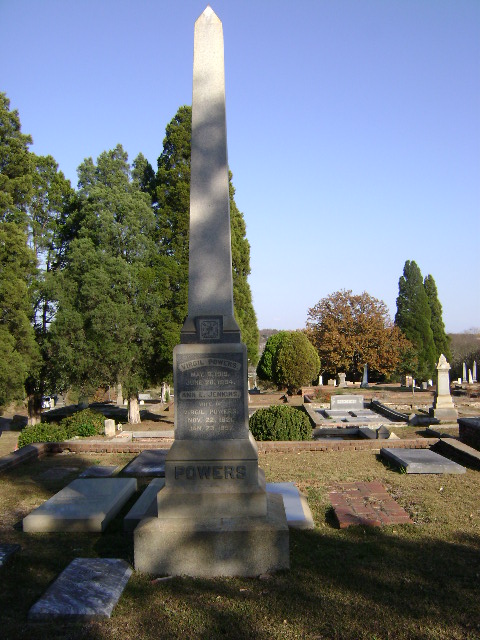
DEATH OF VIRGIL POWERS

A GOOD MAN WHO FILLED MANY IMPORTANT OFFICES.

MACON, Ga., June 20. -- Virgil Powers, State railroad commissioner, public works commissioner of the city of Macon, member of the Bibb county board of education, and trustee of the Georgia Academy for the Blind, died this morning at 10:40 o'clock after several months of illness, at the age of seventy five years. He was for many years superintendent of the Southwestern railroad and also commissioner of the Southern Railway and Steamship Association. He was one of the best known railroad men and leading citizens of the State. The funeral will take place tomorrow afternoon at 5 o'clock. [Columbus Daily Enquirer (Georgia), 21 June 1894, pg. 1]

Virgil and his wife, Ann E. Jenkins, both rest in Rose Hill Cemetery. Virgil was born 9 May 1819 and died 20 June 1894. Ann was born 22 November 1821 and died 23 January 1897.


If you enjoyed this content,
please consider supporting my blog.

24 January 2013

Age is But a Number

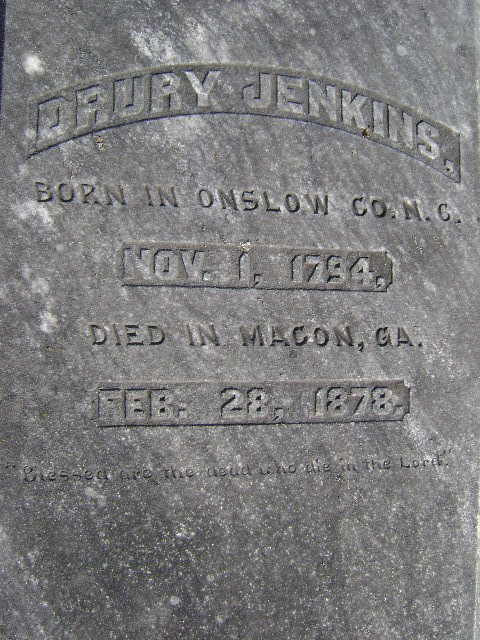
Drury Jenkins
Born in Onslow Co, N.C.
Nov 1, 1794
Died in Macon, GA.
Feb 28, 1878
Blessed are the dead who die in the Lord.

Photo by James Allen
When Drury Jenkins felt duty call in April 1861, he didn't let his age of 66+ years get in the way. He served as a private in Company E of the 3rd Georgia Infantry for more than a year, when he was discharged for "general debility and extreme age." His departure was noted in a letter to the Macon Telegraph (Georgia):
CAMP NEAR RICHMOND,
3d Regiment Georgia Vols.,
June 14th, 1862.
Editor Telegraph: -- The week has passed without one item of interest, in the vicinity of our camp. For the last two days not a gun has been heard from the enemy, to denote that "they are still there," but we know they are...

Uncle Drury Jenkins, of Co. "E," the old veteran of seventy years, has been obliged to succumb, and has received his discharge. We regret his departure from us, for we had all learned to love him. No doubt he will receive a cordial reception upon his arrival home. He is worthy of it...
The same newspaper carried Mr. Jenkins' funeral notice some sixteen years later:
Macon Telegraph and Messenger (Georgia)
2 March 1878, pg. 4
Funeral of Mr. Jenkins
Yesterday afternoon the funeral of Mr. Drury Jenkins was preached at the First Baptist Church.

Dr. Skinner, the pastor, delivered the discourse. After speaking from the words of scripture contained in the sixth verse of the sixty-fourth chapter of Isaiah, of the brevity and uncertainty of life, and that "we all must fade as a leaf," he gave a short sketch of the deceased.

He was been [sic] in North Carolina on November 4th, 1794, moved at an early age to Washington county, where he afterward joined the Baptist Church. He was forty-three years a consistent member. He was in several engagements during the late war.

A fine eulogium was pronounced on Mr. Jenkins as a man and Christian.

At the grave Masonic honors were paid which closed the funeral services.

19 January 2013

In the Sowing, She Lived the Life of the Just

Photo by James Allen
DEATHS AND FUNERALS.
MRS. ANNA D. SHEEHAN.

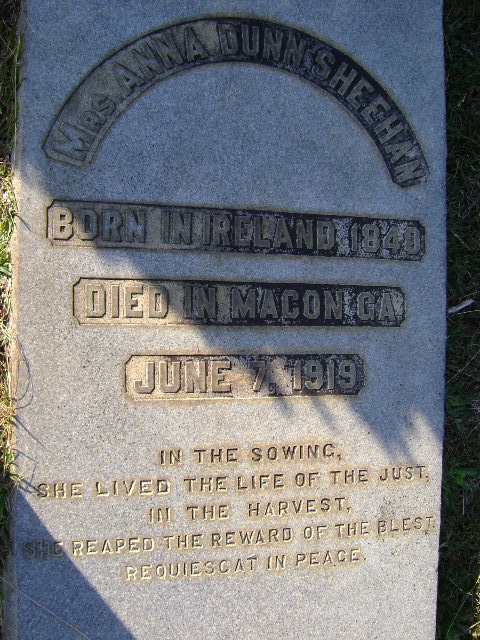
Mrs. Anna D. Sheehan, widow of Dennis Sheehan, died yesterday afternoon at 3:20 o'clock at Mt. De Sales Academy. Mrs. Sheehan was in her 85th year, and had been in declining health for several months. She will be kindly remembered among the older residents of this city, having lived here since early womanhood. Her husband, Dennis Sheehan, was a merchant here and died many years ago. The funeral services will be held at St. Joseph Catholic church this (Sunday) afternoon at 5:30 o'clock, Father Frankhauser officiating. The following will serve as pallbearers: Messrs. Robert Sheridan, Augustin Daly, Jack Coffey, James McMurray, Mr. Callaghan and Giles Hardeman. [Macon Telegraph (Georgia) 8 June 1919, Pg. 10.]

Mrs. Anna Sheehan was born about 1840 in Ireland. She was the wife of Dennis G. Sheehan, and the mother of Thaddeus D. Sheehan.

In the sowing, she lived the life of the just,
In the harvest, she reaped the reward of the blest.

15 January 2013

Thaddeus D. Sheehan Is Claimed By Death (Obituary & Tribute of a Friend)

Photo by James Allen
THADDEUS D. SHEEHAN IS CLAIMED BY DEATH

Well Known Young Man was Found Dead in Bed Yesterday Morning.


Thaddeus D. Sheehan, son of the late Dennis G. Sheehan, was found dead yesterday morning at 9 o'clock when his mother, Mrs. Anna D. Sheehan, went to his room to awake him. The man had been dead several hours.

He was born in Macon May 6, 1879, and was one of the best known young men of the community. Genuine sorrow was expressed by many when the news of his sudden death became known.

When Mr. Sheehan did not appear for breakfast at the usual hour his mother became alarmed and went to her son's room. She was horrified to discover the body cold in death.

The funeral will take place this afternoon at 3 o'clock from St. Joseph's Catholic church, Rev. Father Madden officiating.

Tribute of a Friend.

The following tribute is from a friend:

There was no better known personage in Macon than Thaddeus D. Sheehan. About thirty years ago there was no better known or more universally liked man than Capt. Dennis G. Sheehan, the father. The older citizen will recall the days when Thad, as he was most generally called, was a wee little fellow, the constant companion of his father. His precocity and the love of the father for the boy was known to all. Then came the death of Captain Sheehan, and young as he was it was a great blow to Thad. To the day of his death the love of the son for his father, his devotion to his memory, and the tenderness in which he always spoke of him, and his mother as well, was noted always among those with whom Thad mingled.

In the death of this man, for man he was, the children of the city have lost a great friend. No man loved children more than he, and they, in turn, loved him. He was their friend alway [sic], and their champion. Never would he allow them to be imposed on, and not only was he ever ready to fight their battles and champion their causes, but he was constantly doing something for them, little things it is true, but sufficient to show his love for them. Flowers and children were his idols.

Young Sheehan had his friends, plenty of them. He had a keen sense of honor. Without intention to be too personal, one instance is given to show this truth: It was during the recent municipal campaign. He had friends on both sides, and he was undecided as to how he would cast his vote. He worried over it, and when one day he would decide to vote for Miller he would keep away from his Moore friends. Then he changed and declared he would vote for Moore; but later in the campaign he did some clerical work for the Miller headquarters, and at last he voted for Miller. His reason for this was characteristic. He said while he wanted to vote for Moore, having a greater number of friends on that side, he had accepted money from the Miller people, and his conscience would not allow him to vote against Miller. This is only one instance of many.

Let it be repeated, the children have lost a good friend. [Macon Telegraph (Georgia) 1 January 1910, pg. 7 -- viewed online at GenealogyBank.]

14 January 2013

Can't Leave Thad Alone

Found a few more bits of information about Thad Sheehan. Nothing that would qualify as "insane" characteristics, however. Seems he liked to collect old things -- my kind of guy!

City Items Tersely Told
Old firemanic tournaments will be recalled by perusal of the following words printed on a red badge: "Stonewall Hose Company, Firemanic Tournament, Griffin, July 4, 1889." Thad Sheehan once lived in Griffin, and a few days ago found the badge in the fold of some old papers. [Macon Telegraph (Georgia) 2 December 1906, pg. 5]

Short Stories of the Town
Talking about curios, Thad Sheehan has a walnut plank taken from old Ralston Hall 50 years ago. It is about four feet long, one inch thick and eight inches wide. It was in possession of a member of the Doody family for many years. [Macon Telegraph (Georgia) 13 February 1907, pg. 2]

I found Thad in the Macon City Directory for the years 1904 - 1906 as well as 1908 and 1909. The occupation listed the year of his death was "collr" (collector).

11 January 2013

The Curious Case of Thaddeus Sheehan

Photo by James Allen
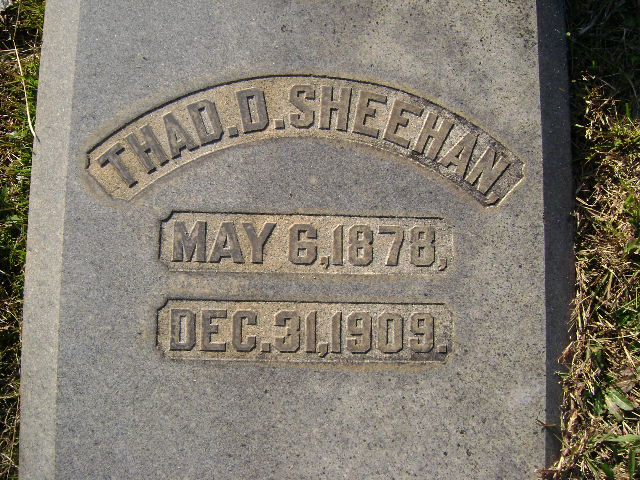
Thaddeus was born to Irish parents Dennis G. and Anna Dunn Sheehan 6 May 1878. He lived just thirty-one years, dying at his home in Macon, Georgia 31 December 1909.

What (if true) makes his life curious to me is an entry found in the 1900 U.S. Federal census for Mount Hope, Baltimore, Maryland. The census, specifically, was for the patients of Mount Hope Retreat. This was a hospital and asylum began about 1840 by the Roman Catholic Sisters of Charity. This facility was described in Baltimore County, its History, Progress and Opportunities (pub. 1916 by the Jeffersonian Publishing Co. of Towson, MD) as "the place where so many unfortunates are cared for and placed on the road to recovery." Per the aforementioned census, a Thad D. Sheehan (age 22, born Georgia) was an "insane patient" at Mount Hope Retreat.

First of all, is this the same Thad D. Sheehan resting in Rose Hill Cemetery? There are connections that seem to suggest so. Mount Hope Retreat was a Catholic facility, and per an obituary, Thad was possibly of the Catholic faith. Furthermore, Mount Hope Retreat was located in Baltimore, Maryland, and I found this tidbit in a local (Georgia) paper: "Mr. Thad Sheehan has accepted the agency for the Baltimore American. His many friends here wish him every success in his new work." [Macon Telegraph, 10 July 1903, Pg. 2] And the 1908 Macon, Georgia city directory lists Thad as a reporter. Makes sense he might have tested the waters in the Baltimore newspaper business -- another connection between Thad in Georgia and Thad in Maryland.

It's the insane part that seems, um, insane? My gut says to write it off as incomplete and/or inaccurate information in the census. Certainly not an uncommon thing. But I do think the Thad in Maryland and the Thad in Georgia are one in the same. I sure would like to know the whole story!

THADDEUS SHEEHAN IS FOUND DEAD
Prominent Young Macon Man Ill Only Short Time.

Macon, Ga., December 31 -- (Special.) Thaddeus D. Sheehan, son of the late Dennis Sheehan, and a young man whose personality and jovial good nature were as well known to every citizen almost as that of members of his own family, was found dead in his bed this morning at the family residence, 1120 Walnut street, by his mother, Mrs. Anna T. Sheehan, when she went to his room to arouse him for his morning meal. He had been slightly indisposed two or three days, and his physical condition was not at all favorable, but he had not chosen to remain indoors and was only yesterday on the streets in the best of spirits.

He was a young man, unmarried. He took great interest in all political affairs about the community, and always had his side, working devotedly to win. He frequented the city hall, paid regular visits to all the officials when they happened to be those for whom he had worked in the elections, and regularly made calls at all the public offices in town. His death was a distinct shock to scores of people. Only his mother survives him. The funeral will occur tomorrow. [Atlanta Consitution (Georgia) 1 January 1910]

03 January 2013

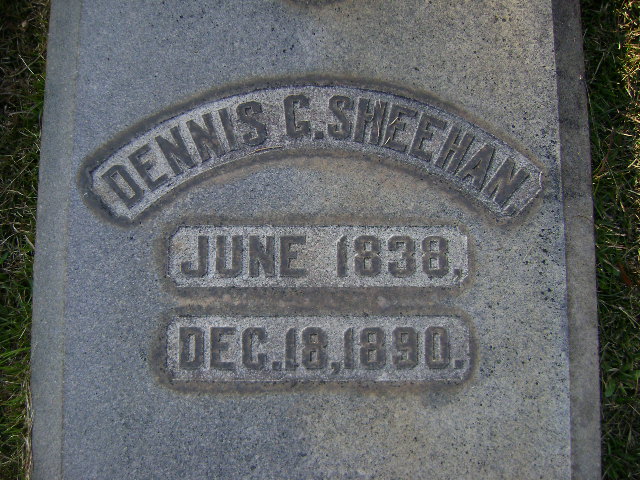
A Good Man Gone: The Death of Mr. Dennis G. Sheehan

Photo by James Allen
"A GOOD MAN GONE.
The Death of Mr. Dennis G. Sheehan, in Griffin. Funeral this Morning.

The funeral of Mr. Dennis G. Sheehan, who died at Griffin on Wednesday evening, will be held this morning at 10 o'clock, from St. Joseph's Catholic church in this city. The interment will take place at Rose Hill.

Mr. Sheehan was for many years a citizen of Macon, and there are numbers of prominent people here to whom the news of his death was a sad surprise. During his long residence in this city he was connected with several dry goods firms, and was considered one of the best posted men in the profession.

He went to Griffin as the manager of a branch store of W. C. Lyons & Co., in that city, and was engaged in that capacity when he died. He leaves a wife and son to mourn his untimely departure." [Macon Telegraph (Georgia), 20 December 1890, pg. 6]

Dennis was born in Ireland.  His wife and son, buried nearby, were Mrs. Anna Dunn Sheehan (1840-1919) and Thad. D. Sheehan (1878-1909).

12 July 2012

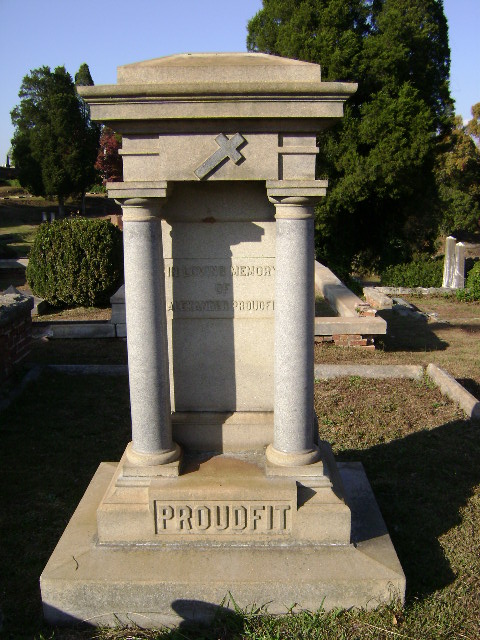
Death Comes Suddenly to Alexander Proudfit

Photo by James Allen
Alexander Proudfit was a prominent Maconite -- lawyer, judge, and trustee of the Georgia Industrial Home. He was born 28 October 1841 in Tennesse, and census records suggest his parents were William and Eliza Proudfit. Aleck came to Macon shortly after reaching adulthood and first married Minona Bartlett, only daughter of George T. and Virginia L. Bartlett. She passed away in 1874. Twenty or so years later, Alexander Proudfit married Bessie Napier and fathered at least three children. His death on 3 November 1913 seemed sudden, yet was not totally unexpected.

Macon Telegraph (Georgia)
4 November 1913
DEATH COMES SUDDENLY TO ALEXANDER PROUDFIT

Expires After He Had Gone To Bed Last Night,

REFEREE FOR 16 YEARS

Previous to That Time He Was One Of Macon's Best Known Lawyers -- Four Weeks Ago He Collapsed While in Attendance at Church.


Alexander Proudfit, referee in bankruptcy, one of the best known and loved men in Macon, died suddenly last night between 11 and 12 o'clock at his home, 129 Jefferson street. The end came a short time after Judge Proudfit had talked with Mrs. Proudfit and had turned over in his bed and dropped off to sleep. When physicians arrived, it was found that he had breathed his last.

For some time Judge Proudfit had been in failing health, but had not been confined to his bed. Yesterday he was down at his office and last night ate a hearty supper and was not heard to complain in the least of feeling badly. His friends were aware, however, that he might drop off any time, for only four weeks ago he collapsed while in attendance at the morning service at the First Baptist church, and had to be taken home in an automobile, though he recovered shortly afterward.

No man in Macon was better known or had more friends than did Judge Proudfit and the announcement of his death will cause widespread regret not only in Macon, but wherever he was known. For sixteen years he had been referee in bankruptcy for this division and previous to that time had been one of the leading lawyers in Macon.

Native of Tennessee.

He was about 68 years of age and came to Macon shortly after he reached his majority, from Brownsville, Tenn. Besides his widow, Mrs. Bessie Proudfit, Judge Proudfit leaves two daughters, Misses Consuelo and Pearl Proudfit, of Macon, and one brother, John Proudfit, of Mississippi.

Mrs. Proudfit is a sister of J. H. and E. Tris Napier, of Macon, and Mrs. Mark O'Daniel, of Jeffersonville.

For many years Judge Proudfit had been a member of the First Baptist church and was a liberal giver to all worthy objects. It is said of him that there was nothing within his power that he would not do for a friend and there are many people in Macon who can attest to that fact...
Macon Telegraph (Georgia)
5 November 1913, pg. 11
DEATHS AND FUNERALS
ALEXANDER PROUDFIT

With an escort from the Macon Bar association, of which he was a long time and distinguished member, the funeral of Judge Alexander Proudfit, whose death occurred Monday night, will be held this afternoon at 3:30 o'clock from the First Baptist church, Dr. E. C. Dargan, the pastor, officiating. Interment will follow in Rose Hill cemetery...

News of the sudden death of Judge Proudfit was learned with sorrow yesterday by a host of friends throughout the city, and among them the hundred children at the Georgia Industrial Home, of which Judge Proudfit was a trustee for a number of years.
Macon Telegraph (Georgia)
6 November 1913, pg. 5
Deaths and Funerals
ALEXANDER PROUDFIT

In the presence of many sorrowing friends and relatives, Dr. E. C. Dargan, pastor of the First Baptist church, pronounced a beautiful tribute over the body of Judge Alexander Proudfit, whose funeral took place from the First Baptist church yesterday afternoon at 3:30 o'clock.

The sentiment of the minister was also that of the great audience, particularly members of the Macon Bar association, of which Judge Proudfit had been a member for many years...

Many beautiful floral offerings, piled high on the casket, showed the high esteem in which the deceased had been held by his friends, his church and other Macon institutions, which he had aided...

10 July 2012

Louis Juhan Dead! (Tombstone Tuesday)

© 2012 S. Lincecum
Louis Nottingham Juhan was born 1 November 1875 in Georgia to William A. and Elizabeth Jane Juhan. Two of his siblings were John Ross and William J. Juhan. John Ross is buried in the same lot of Rose Hill Cemetery as Louis and his parents. William J. rests just down the road in Riverside Cemetery.

Macon Telegraph (Georgia)
11 September 1909, pg. 2
DEATHS AND FUNERALS.
JUHAN.

Mr. Louis Nottingham Juhan died at the home of his brother, Mr. W. J. Juhan, at 1:45 yesterday, after an illness of some two months.

Ever since it became known that Louis Juhan was confined to his bed by sickness, there were anxious inquiries after his condition. He was missed by his friends, friends who knew and loved him, friends accustomed to his smiling greeting and warm hand clasp, and they longed for his bright presence.

These friends waited for him, and as the days passed they expected to find him among them at any time. So when the news of his death was made known it came as a distinct shock. Louis Juhan dead! It was as a blow. And as the first shock wore away, those who knew wondered if it could be true. There were many who knew nothing of his serious illness, and to these the news brought a pain to the heart.

Macon Telegraph (Georgia)
5 October 1899, pg 23
Image from GenealogyBank.
He was only 34 years old, and had lived all his life in Macon, having been connected with his brother with the Union Dry Goods Co. since its organization. From a boy he had the faculty of making friends, of making people love him. Thus he became popular throughout the city, and with all classes. As boy and man he was beloved by all, and his death will be mourned by many.

He is survived by two brothers, Mr. W. J., of Macon, and Mr. Chas. J., of Dallas, Tex., and one sister, Mrs. J. W. Spencer, of Cuthbert.

The funeral will be held at 4 o'clock tomorrow afternoon, that his brother Charles may arrive from Texas. More definite information of the funeral arrangements will be announced later.
Macon Telegraph (Georgia)
13 September 1909, pg. 2
DEATHS AND FUNERALS
JUHAN.

The funeral services of Mr. Louis N. Juhan took place yesterday afternoon at 4 o'clock from the residence of his brother on Oglethorpe street. His brother, Chas. J. Juhan, arrived from Texas just in time for the funeral...The Macon Volunteers, of whom Mr. Juhan was once a lieutenant, attended the funeral in a body, and fired three volleys from their rifles and sounded taps over the grave. Interment at Rose Hill cemetery.

13 June 2012

A Death, a Funeral, and a Card of Thanks (Wednesday's Child)

Photo by James Allen
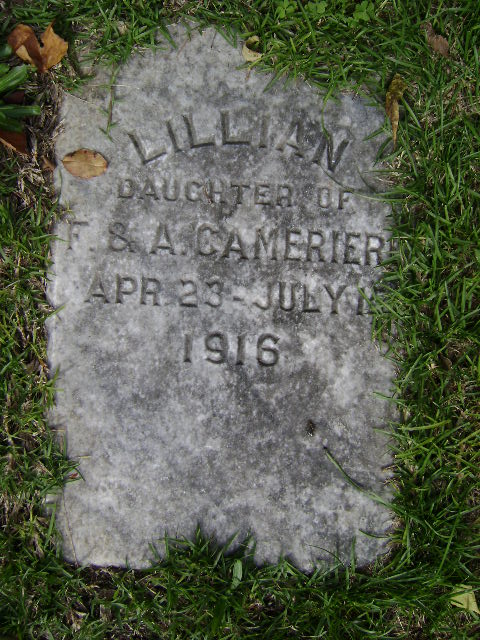
"Deaths and Funerals
LILLIAN CAMERIERO

The many friends of Mr. and Mrs. Frank M. Cameriero sympathize with them in the loss of their youngest daughter, Lillian, whose death occurred yesterday morning at 9:30 o'clock at the family residence, 401 Walnut street. The little girl had only been sick for a few weeks and her death was unexpected.

The funeral services will be held this afternoon at 4:30 o'clock at St. Joseph's Catholic church, Father Frankhauser officiating. Interment will be in St. Joseph's cemetery." [Macon Telegraph, Georgia, 19 July 1916]

Macon Telegraph (Georgia)
21 July 1916
A CARD OF THANKS
Mr. and Mrs. Frank Cameriero and family desire to express their deep appreciation...for the many beautiful expressions of friendship shown during the sad bereavement of the family in the loss of their infant daughter, Louise Cameriero.

12 June 2012

Oops! Frank Cameriero Did it Again. (Tombstone Tuesday)

Macon Telegraph, Georgia, 13 July 1909
Frank Cameriero was a barber. It's what he did. And apparently, he was very good at it. Local newspapers called him a "tonsorial artist,"1 and said he operated "the very best tonsorial institution in Macon."2

City directories further illustrate this. Macon, Georgia directories from 1904, 1906 - 1909, 1914, and 1917 - 1918 accessed via Ancestry.com show Frank as either a proprietor of a barber shop or at least an employee in one.3 What in the world then, was F. Cameriero doing on a September 1911 list of people alleged to have violated the prohibition statute?4

It seems that sometime around 1910, if not before, Frank Cameriero got into the "soft drinks" business. This is bore out by the 1910 U.S. Federal Census5 and 1911 Macon, Georgia City Directory,6 both listing such as Frank's occupation.

The next newspaper article I came across stated Frank Cameriero plead guilty on pending charges of violating the prohibition law:
PLEAS OF GUILTY MADE IN PROHIBITION CASES
Cameriero...Signs Affidavit That He Will Never Sell Whisky Again

Frank Cameriero now has a clean slat with the city court, a number of cases charging violation of the prohibition law which had been pending against him being disposed of yesterday, a plea of guilty being entered in three cases, while two others were not prossed.[sic]

Cameriero presented an ex culpe affidavit to Judge Hodges, in which he promised never to engage in business of that character again. [Macon Telegraph, Georgia, 31 August 1913]
But (oops!) Frank did it again.
POLICE FIND WHISKY WHILE MAKING RAIDS
Frank Cameriero Has Three Drums in His Place

...Yesterday morning the police swooped down on a bar run by Frank Cameriero at 225 Fifth street. They were armed with search warrants and succeeded in unearthing two and a half drums of whisky which they found in the place. Cameriero had only been in the near beer business at this location a few days. He was released under a bond of $200.

The police also claim to have evidence of a sale of whisky made at Cameriero's place... [Macon Telegraph, Georgia, 26 October 1914]
Frank again plead guilty:
Local News Bits
Cameriero Gets Off Light

Because his place of business had been open only three days when raided by the police and charges of violating the state prohibition law placed against him, Judge Hodges was unusually lenient on Frank Cameriero in the city court of Macon yesterday, when the defendant entered a plea of guilty. Judge Hodges only required him to pay the court costs... [Macon Telegraph, Georgia, 15 January 1916]
Photo © 2012 S. Lincecum
Frank Cameriero (1874-1935) and his wife Angelina (1885-1929) were both born in Italy. They rest in St. Joseph's Catholic Cemetery section of Rose Hill. A kind reader and descendant of Frank Cameriero told me Angelina was the daughter of Nicholas Cameriero's second wife. Nicholas and Frank were brothers.7


Footnotes:

1. "A Popular Barber Makes A Change," The Macon (Georgia) Telegraph, 21 June 1906; digital image, GenealogyBank (http://www.genealogybank.com : accessed 11 June 2012), Historical Newspapers Archive.
2. "Frank Cameriero Moves Shop Into New Quarters," The Macon (Georgia) Telegraph, 13 July 1909; digital image, GenealogyBank (http://www.genealogybank.com : accessed 11 June 2012), Historical Newspapers Archive.
3. "U.S. City Directories, 1821-1989 (Beta)," database, Ancestry.com Operations, Inc., Ancestry.com (http://www.ancestry.com : accessed 11 June 2012), entries for Frank Cameriero.
4. "40 Prohibition Cases," The Macon (Georgia) Telegraph, 9 September 1911; digital image, GenealogyBank (http://www.genealogybank.com : accessed 11 June 2012), Historical Newspapers Archive.
5. 1910 U.S. census, Bibb County, Georgia, p. 7A, line 19, Frank Caneriero; digital image, Ancestry.com (http://www.ancestry.com : accessed 11 June 2012); citing National Archives and Records Administration microfilm publication T624.
6. "U.S. City Directories, 1821-1989 (Beta)," database, Ancestry.com Operations, Inc., Ancestry.com (http://www.ancestry.com : accessed 11 June 2012), entry for Frank Cameriero.
7. Nina Fort (e-address for private use), to Stephanie Lincecum, e-mail, 7 June 2012, "Re: Rose Hill Cemetery; Macon, Georgia," Rose Hill Cemetery Project & Family Tree Maker Files; privately held by Lincecum, e-address & street address for private use, Georgia.

07 June 2012

Prepare for Your Death, Mr. Nicola Cameriero

MR. CAMERIERO GETS BLACK HAND LETTER.
Well Known Italian Merchant Receives Mysterious and Threatening Missive.

Mr. Nicola Cameriero, one of the most prominent of the Italian merchants of Macon, renounced his allegiance to Victor Emanuel of Italy yesterday and became a citizen of the United States, and Macon in particular.

He was therefore somewhat shaken up yesterday morning when in his mail was a suspicious looking letter addressed to Mr. Nicola Cameriero, 357 Fourth street, Macon, Ga., and postmarked at Macon the day before.

When he opened the letter he saw only a few lines, but these were accompanied by some pictures. The letter read as follows:
"Prepariti per la tu morte."
"Ioe ultima."

Which translated read: "Prepare for your death."
"First and last."

In the right hand corner is a hand pointing downward to four short straight marks as if underscoring the hand. On the left hand side was a rudely drawn pocketbook and a Maltese cross, while underneath were the figures $200.

That was all there was to the letter, and it was as much of a puzzle as a black hand letter, if a black hand letter.

Mr. Cameriero has an idea who sent it to him, and he is laying low so as to fasten his suspicions. He does not believe in any such foolishness, and the writer will suffer if his suspicions are correct.

The letter may, or may not, have been a joke, but if it is the writer has struck the wrong man. Mr. Cameriero is a full fledged American citizen now, and he will be protected. He does not think that the letter had any connection with his having taken out his naturalization papers, but it was something of a coincidence that it should be received on the very day he became a citizen. [Macon Telegraph, Georgia, 27 May 1909]


Nicholas Cameriero was born about 1863 in Viggiano, Italy. He was first married to Ella English 28 December 1887 in Bibb County, Georgia. The first Mrs. Cameriero died 23 December 1895, just hours after giving birth to their second child. The following year, on November 15th, Nicholas married Marie/Mary F. Nicolia:
MARRIED.
Sunday morning, Nov. 15, 1896, at 8 o'clock at St. Joseph's Catholic church, Nickalous Cameriero and Mrs. Francisco Nicolia, from Italy. They have taken up their abode at his residence, No. 420 Mulberry street, Macon, Ga. [Macon Telegraph, Georgia, 16 November 1896, page 4]
Nicholas Cameriero died 13 August 1937 and was laid to rest next to his first wife in the Cameriero lot of St. Joseph's Catholic Cemetery section at Rose Hill Cemetery.

31 May 2012

Mrs. Ella Cameriero Deserted By, Then Reunited With Husband?

Hmmm... I wonder what happened here.
In Need of Help.
A sad case of need can be found by the charitably inclined this morning at No. 355 Fourth street.

Mrs. N. Cameriero, formerly Miss Ella English of Marshallville, who was deserted by her husband several days ago is in destitute circumstances and in need of work.

Competent to do all kind of needle work, she finds herself unable to maintain herself for want of employment. The ladies of the city are appealed to in this matter. [Macon Telegraph, Georgia, 28 November 1888]
The above notice was published less than a year after Ella and Nicholas were married, as they were united in matrimony 28 December 1887.

I wanted to determine if Ella was still married at the time of her death seven years later. A database search produced no results, so I went page by page of the 24th and 25th December 1895 editions of The Macon Telegraph, finding it hard to believe there was no mention of her death. The first find on page 8 of the 24 December edition speaks of Ella's death:
MRS. CAMERIERO DIED.
The Funeral Will Take Place Today at the Catholic Church.

Mrs. E. N. Cameriero died at the residence, 418 Mulberry street, yesterday.

The interment will take place today, the funeral services to be held at St. Joseph's Catholic church at 9:30 o'clock.

Mrs. Cameriero was well known in Macon, where she spent the greater portion of her life. Before her marriage she was Miss Ella English.
Not enough information, so I kept going. The next day's news included the following:
BURIED ON HER ANNIVERSARY.
Mrs. Cameriero's Funeral Occurred on Her 29th Birthday Anniversary.

The death of Mrs. E. N. Cameriero was peculiarly sad. On her 29th birthday anniversary she was buried in Rose Hill cemetery.

She had been a loving wife and a devoted Christian, being a member of the Roman Catholic church. Her bereaved family consist of a sorrowing husband, and two little chldren, one little babe only a few hours old when its mother died. The other child is a bright little boy. Mrs. Cameriero's mother lives in Atlanta.

07 April 2012

Death and Funeral of Edward McCrudden

Macon Telegraph (Georgia)
Wednesday, 30 March 1921, pg. 3
DEATHS AND FUNERALS
EDWARD MCCRUDDEN

Edward McCrudden, 84 years of age, one of the oldest residents of Macon, died at 6 o'clock last night at his residence, No. 453 Arch street, after an illness of only one day.

Mr. McCrudden was born in Donegal, Ireland, and came to Macon sixty-five years ago, entering business here, in which he continued up to the time of his death.

He is survived by one sister, Miss Margaret McCrudden, of Ireland, and one niece, Miss Mary A. Gallagher of Macon. He was a member of St. Joseph's Catholic church. The funeral will be held Thursday, arrangements to be announced later.
Macon Telegraph
Friday, 1 April 1921, pg. 3
DEATHS AND FUNERALS
EDWARD MCCRUDDEN

The funeral of Edward McCrudden, whose death occurred at 6 o'clock Tuesday afternoon, was held from St. Joseph's Catholic Church, Thursday afternoon at 3 o'clock. Rev. Father Murphy conducted the services and interment was in the family lot at St. Joseph's Cemetery. The following served as pallbearers: John Murphy, Pat Cassidy, John Gillispie, John McBrearty, Joe Thomas and Pat McNeils.
According to his death certificate, Edward was the son of Daniel McCrudden and Margaret Bern, both of Ireland. His occupation was Merchant.

Edward's brother John is also buried in the family lot, as is his niece Mary A. Gallagher. John McBrearty, one of Edward's pallbearers, was written about a few days ago. John (d. 1961) is buried in a lot across from Edward McCrudden. As stated above, all are in the St. Joseph's Catholic section of Rose Hill Cemetery.

04 April 2012

John McBrearty Convicted of Violating the "Blind Tiger" Law

"Blind Tiger" (a term popular in the southern states) is a lower class version of a speakeasy, a place that illegally sold alcohol during Prohibition. Prohibition in Georgia, by the way, was from 1908 until 1935. This started well before and went on after the national prohibition of 1920 to 1933. In a mid-September 1914 week in Macon, seventy prohibition cases were on the docket for the city court. John McBrearty was one such case.

Macon Telegraph (Georgia)
10 February 1914, pg. 8
SECOND RAID MADE ON JOHN M'BREARTY'S STORE

Police Secure a Barrel of Whisky and Claim to Have Evidence of a Sale. McBrearty Denies Ownership.


For the second time since the first of the year, the police have raided John McBrearty's grocery store on Monroe street and gotten sufficient whisky to warrant charges of violation of the city blind tiger ordinance and the state prohibition law. The last raid was made last night by Chief Riley and Plain Clothes Officers Morris and Dave Riley.

Not only was a barrel of whisky taken from McBrearty's place, but a sale is also alleged to have been gotten on him, which the officers are confident will "stick" when the case comes to trial. McBrearty declared the whisky did not belong to him and that he knew nothing about it.
I conducted some research in an effort to make sure this article pertained to the John McBrearty (1882-1961) resting beside his wife Margaret Thomas (1882-1957) in the St. Joseph's Catholic Cemetery section of Rose Hill. The 9 April 1930 Federal census for Macon, Bibb County, Georgia lists John with his wife Margaret and son John F. (1913-2005, also buried in same plot as parents). John and Margaret were both born in Ireland and immigrated to the United States in the early 1900's. They were married about 1911.

In the 1920 census (same family, same locale), John is listed as a retail grocery store owner. And in the 1918 Macon City Directory, John is listed (with Margaret) as being a grocer at 336 Monroe.

In late June 1915, after John exhausted his appeals, the final ruling came down:

Macon Telegraph (Georgia)
23 June 1915, pg. 11
"TIGER" CASE AFFIRMED

John McBrearty Must Pay Fine of $150 Imposed by the Recorder


Clerk R. A. Nisbet, of the superior court, yesterday received notice that the court of appeals had affirmed the judgement of the superior court in the case of John McBrearty, convicted at the February term, 1915, of violating the "blind tiger" law...McBrearty was sentenced to pay a fine of $150 or work sixty days on the county roads.
Another interesting find was John McBrearty in the 1910 Macon, Bibb County, Georgia Federal census. He was working for grocery merchant John Moss (born Ireland) as a Near-Beer clerk. Seems John McBrearty really was in the "thick of things" during Prohibition!

03 April 2012

Mislocated and Misnamed? (The One Where Obituaries and Tombstone Conflict.)

James Daniel Stetson
Born May 30, 1846
Died March 18, 1901
"He Giveth His Beloved Sleep"

His Wife
Eugenia Sophia Pate
Jan 28, 1852 - July 31, 1906
Obituaries of this sort give genealogists fits. Was she buried at Hawkinsville or Macon? Was his first name John or James?

Macon Telegraph (Georgia)
1 August 1906
MRS. EUGENIA STETSON PASSES AWAY AT HOME

Widow of the Late J. D. Stetson, and One of the Most Prominent Women in Macon's Charitable Circles, Dies After Short Illness.


Mrs. Eugenia Stetson, the widow of the late J. D. Stetson, died about 4:30 o'clock yesterday afternoon at the home of the family at 360 College street.

Mrs. Stetson had been ill only a short while. She was aged 55 years. She was one of the most prominent women in the charitable circles of Macon, the splendid Methodist Orphanage being one of the institutions, upon which she bountifully bestowed her time and energy, not to mention her worldly goods.

The death of Mrs. Stetson comes rather as a surprise and shock to hundreds of people in Macon and elsewhere, who were not aware that she was seriously ill. The announcement of the death will strike sorrow into the hearts of a host of loving friends and admirers, and will cast a gloom over almost the entire city.

The deceased was a woman of beautiful and consistent character. Charitable almost to a fault, loving to all and withal possessing a sweet, gentle, sunny nature, she had entwined herself about the heartstrings of a host of [...illegible...] felt as a personal and irreparable loss.

[...Illegible...], the daughter of the late Major John H. Pate, of Hawkinsville. She was born in that city in January, 1852. Her late husband, J. D. Stetson, was for many years the president of the American National Bank.

The following relatives survive Mrs. Stetson: Four brothers, R. O., M. C., J. W. and R. A. Pate, all of Hawkinsville; one sister, Mrs. W. B. Steele, of Hawkinsville; her mother, Mrs. Z. A. Pate, of Hawkinsville; and the following children: J. P. Stetson, of Macon; Mrs. Sam T. Coleman, of Macon; E. W. Stetson, of Fitzgerald, and James D. Stetson, of Macon.

Mrs. Stetson was a devout member of the Mulberry Street Methodist Church. The funeral will be held this afternoon at 1:30 o'clock at the residence. The interment will occur this afternoon at Hawkinsville.

A special train will convey the body to Hawkinsville, leaving the Southern depot at 2:30 o'clock, and returning at 7:30 o'clock this evening. The friends of the family are invited to attend the interment at Hawkinsville.

The following will act as pallbearers: R. A. Merritt, R. J. Taylor, W. R. Rogers, Jr., O. E. Dooly, W. P. Glover, B. E. Willingham, A. R. Willingham, T. J. Simmons, Jr.
For what it's worth, the burial records of Rose Hill Cemetery list Mrs. Eugenia Stetson, and there is no indication at the family burial plot in the Central Avenue division that Eugenia's inscription on her and J. D. Stetson's tombstone is a cenotaph.

Here's another one. I find it a bit odd that possible misinformation was provided in obituaries for both husband and wife, who died 5 years apart.

Augusta Chronicle (Georgia)
19 March 1901
JOHN D. STETSON, MACON, DEAD
Macon, Ga., March 18. -- Mr. John D. Stetson, vice president of the American National bank of this city, and a prominent financier in the state, died here today.
Stetson Family Plot at Macon's Rose Hill Cemetery
Photos © 2012 S. Lincecum