02 March 2026

Alfred Jackson Vining Stayed at His Post to the Last

 
At one time in the American South, the railroad was both its lifeblood and a site of frequent tragedy. In the late 1800s, being a locomotive engineer, like Alfred Jackson Vining, was statistically among the most dangerous jobs in America. Whenever at work, for the engineman and his crew, life depended on a pocket watch and a prayer. The Safety Appliance Act of 1893 mandated railroad companies use air brakes and automatic couplers, but the transition was slow since the law wasn't fully enforceable until 1900. Many trains still relied on manual "link and pin" coupling—often resulting in crew members being crushed between cars—and hand-operated brakes, though the Central of Georgia, for which Alfred ran freight, was working to modernize.

Alfred, his wife Emma, and their three daughters lived on 4th Street in Macon, Bibb County, Georgia, just a few blocks from the rail yards. The "call boy," a young railroad employee sent to wake up crew members for their shifts, likely knocked on Alfred's door the night before he was scheduled to run freight to Alabama, notifying him of the hour he was to report to the yard. The date of the run was 24 November 1899, just a few days after Alfred and Emma's eleventh wedding anniversary and less than a week before Thanksgiving.

It was a chilly fall morning. After performing a walking inspection of his "iron horse" and conferring with his fireman, Alfred began the trip, using his certified pocket watch to navigate by the timecard. After hours of being violently jolted in the scorching hot and deafeningly loud cab—seemingly just another day at the throttle—the end came for Alfred about one in the afternoon near Georgetown, Quitman County, Georgia, and the bridge over the Chattahoochee.

The following transcription is from the 25 November 1899 Americus Times-Recorder (Georgia).
ENGINES COLLIDED; ENGINEERS KILLED.

A Head End Smashup on the Central Yesterday.

ACCIDENT NEAR EUFAULA, ALA.

Freight Trains Crash Together and Brave Men at the Throttle Lose Their Lives in the Disaster.—Many Cars Badly Broken.

A fearful head-end collision between two freight trains of the Central of Georgia Railway occurred yesterday afternoon at 1 o'clock between Eufaula and Georgetown, resulting in the death of both brave engineers and the probable injury of others of the crew.

The engineers were Cliff McManus and Alfred Vining.

The trains were numbers 33 and 34, running between Smithville and Montgomery, and the collision occurred at a point near Georgetown, on the Georgia side of the river.

The crash of the iron giants was terrific, and engine reared against engine in deadly embrace despite the herculean efforts made by both engineers to bring the trains to a stop. Both engines were wrecked, as were a number of freight cars.

It is said that Engineers Vining and McManus stuck to their posts to the last and went down in the debris of broken iron and twisted steel, while hissing steam shut out the terrible spectacle for a time.

Engineer Vining, it is said, was buried beneath the debris, his body not being found until nearly an hour afterwards.

Engineer McManus was well known in Americus and his wife, who was Miss Wells, of Smithville, has relatives here. He was a young man and, like Mr. Vining, an excellent and careful engineer.

It is not known how many of the crew were injured or to what extent, though it was reported that both firemen were scalded and one of the conductors hurt quite badly. The dead engineers and the injured ones were carried to Eufaula.

Just what caused the accident is not known, but certainly someone blundered. The wrecking train passed Americus an hour or two after the collision, en route to clear away the fearful wreck.
An article in the 29 November 1899 Dawson News (Georgia) offered further detail:
Engineer McManus was found leaning out of his cab window dead, and Engineer Vining was so tightly wedged in between the engine and tender that it took several hours hard work to get him out.

The accident is said to have been due to misinterpretation of orders by Engineer McManus.
Alfred Jackson Vining was buried in the Cabiness Ridge section of Rose Hill Cemetery. Per a burial notice published in the Macon Telegraph, "the funeral was largely attended, as Mr. Vining was very popular. The procession was one of the largest seen in Macon for a great while."

(Image by Dr. Jim via FindAGrave)

Clifford McManus (1864-1899), engineer of the other train in the deadly collision, was laid to rest in Smithville Cemetery in Lee County, Georgia. He was also a father of three.

Genealogical Notes:
  • Alfred Jackson Vining was the son of Jackson LaFayette Vining (1833-1899), who died about seven months before his son, and Sarah Caroline Glover.
  • Emma Delilah Jernigan (1872-1962), Alfred's wife, was the daughter of William Henry Jernigan and Emily Louise McDowell.
  • Alfred and Emma were married 21 November 1888 in Bibb County, Georgia. Their children were Myra L. (1890-1981), Zitelle (1892-1981), and Virginia "Jennie" (1897-1986).
  • Emma never remarried after Alfred's death. Though she can be found in Bibb County for the 1900 census, she had taken her daughters to Headland, Henry County, Alabama by 1910 and remained there for the rest of her life. Notably, Emma and her daughters each lived to be approximately 90 years old.

More Railroad Men in Rose Hill Cemetery:


If you enjoyed this content,
please consider supporting my blog.

05 January 2026

Northern Craftsmanship in a Southern Landscape

Georgia Journal and Messenger, 3 May 1854
Rose Hill Cemetery in Macon, Bibb County, Georgia is rarely mentioned in the same breath as Mount Auburn or Green-Wood. Yet it belongs unmistakably to the same 19th-century garden (or rural) cemetery movement, when Americans began to rethink how the dead should be remembered and where the living should encounter them. Established in 1840 on rolling ground above the Ocmulgee River, Rose Hill reflects the ideals of the movement—winding paths, carefully framed views, and monuments meant to converse quietly with the landscape rather than dominate it. Though regional in scale and ambition, it reveals how those national ideas traveled south, taking root in Georgia soil and producing a burial ground that was at once commemorative, civic, and contemplative. It is within this context—influential and deliberate—that the presence of two marble gravestones signed by a Connecticut maker begins to tell a larger story.

Though Macon had a prominent grave carver in James Artope, many of Rose Hill's early monuments were not carved locally but produced in Northern marble centers and shipped south, not only reflecting the expanding reach of 19th-century stone manufacture and distribution, but also that Maconites had cosmopolitan taste and participated in national artistic trends. Among these are two gravestones bearing the signature of John Ritter, a marble manufacturer working in New Haven, Connecticut, in the mid-nineteenth century. The presence of his work in Macon speaks to the ease with which funerary forms, materials, and aesthetics crossed regional boundaries, linking a Southern garden cemetery to Northern workshops through trade, taste, and shared commemorative language. These signed stones offer tangible evidence that Rose Hill was not a provincial outpost, but an active participant in the broader funerary economy of its time.

Two Daughters of James Hicks Hardaway

Margarett Indiana Hardaway departed this life 23 July 1843 in Macon, Bibb County, Georgia at the age of just 21 years. And it was her death that precipitated the purchase of a lot in the Central Avenue division of Rose Hill Cemetery by her father, J. H. Hardaway. Her gravestone, featuring an elegant border, is possibly the first he commissioned from John Ritter of New Haven, Connecticut.

Sacred to the Memory of
Miss Margarett Indiana Hardaway,
who departed this life,
July 23, 1843,
Æ 21 years & 23 days.

"It is not all of life to live,
nor all of death to die."

And thou art now where sunshine is Immortal,
In the bright regions of eternal joy.

Margarett's older sister died on 8 February 1851. For Ann's memorial, commissioned roughly eight years later, the family again turned to Ritter, this time selecting a stone characterized by a striking Gothic arch.

Sacred to the Memory of
Mrs. Ann Eliza,
wife of Robert Carver,
who died Feb'y 8, 1851,
Æ 36 years, 7 months & [?]

"Blessed are the dead who died in the Lord."

In the bottom left corner of each of the gravestones pictured above is the signature of John Ritter.

J. Ritter
N. Haven, Ct

A Dynasty of Stone Carvers

Connecticut Herald, 1823
John Ritter, his father David, and other members of the family were highly prominent stone carvers of New Haven, Connecticut, and their influence spanned over a century. Beginning in the mid-18th century, early members were known for a distinct folk-art style featuring simple faces with down-curved wings. By the 19th century, the family moved toward more sophisticated marble yards and monumental works.

New Haven was a hub for high-quality marble crafts. Stones were often carved there and shipped down the Atlantic coast to ports like Savannah, Georgia, then brought inland to cities such as Macon. (It's even possible they arrived by steamboat on the Ocmulgee River, which Rose Hill Cemetery overlooks.) Ordering a signed stone from a famous New Haven carver was a statement of status and ensured the finest craftsmanship for deceased loved ones. Signed stones such as the two featured here are conclusive evidence of the coastline marble trade.

After John took over the marble factory from his father, he made it a point to advertise in newspapers up and down the Atlantic coast and employed authorized agents in cities such as Macon to make it easy for local families to order. Ads in the Georgia Journal and Messenger newspaper of Macon even noted that various patterns of Ritter monuments could be seen in Rose Hill Cemetery, using the park-like space as a gallery for his work. This marketing hook proved that the Ritter marble monuments were a recognizable status symbol.

Ultimately, the signature of John Ritter etched into the marble at Rose Hill does more than just document a 19th-century trade route. It serves as a lasting bridge between a Northern workshop and a Southern family’s grief. While the steamboats that once traversed the Ocmulgee have long since vanished, these tangible and elegant stones remain. The next time you walk through a cemetery, look closely at the base of the monuments; you might just find a name that tells a story spanning hundreds of miles and nearly two centuries.


If you enjoyed this content,
please consider supporting my blog.

01 January 2026

The Napier Children: a Feared Illness and a Family's Loss

In the fall of 1859, the John Thomas Napier family of Bibb County, Georgia experienced the kind of tragedy that haunted countless 19th-century households: the devastating loss of two young children within a span of less than five weeks. Their story, preserved in stone at Rose Hill Cemetery in Macon, offers a window into both the fragility of childhood in the antebellum South and the elaborate mourning culture that sought to memorialize such losses.

"He taketh his young lambs home."
Gravestone for Eugene S. and Anna C. Napier, both of whom died in 1859.
Rose Hill Cemetery
Image © 2013-2025 S. Lincecum

The Family

John Thomas Napier was born 27 October 1823 in Putnam County, Georgia, the son of Skelton Napier (1800-1866) and Jane Ector Gage (1804-1891). John married Frances Camilla "Fannie" Jameson on 17 May 1848 in Macon, Bibb County, Georgia. Fannie was the daughter of David Jameson (1793-1861).

John and Fannie had at least five children: Eugene Skelton, John J., Anna C., Fannie T., and Robert Lee. I lose track of John J. after 1880, but I can say Fannie T. went on to marry Julius Carl Mayr (1857-1889) and have children of her own. The other three children of John and Fannie Napier died young.

John and Fannie's financial circumstances improved significantly around 1860 when Fannie inherited a substantial amount of property in Houston County, Georgia. This would provide financial stability during a period of profound personal loss as well as dramatic political and wartime upheaval. The family maintained connections to the neighboring counties of Houston and Bibb throughout the remainder of their lives.

The Tragedy Unfolds

In late October 1859, Eugene Skelton, namesake of his grandfather, died of inflammatory croup at the age of 7 years and 5 months. That same day -- in a father's desperate acknowledgment of mortality -- John T. Napier purchased a family plot in the Ivy Ridge division of Rose Hill Cemetery. An act of immediate necessity would, unfortunately, prove prescient.

Approximately a month later, in late November 1859, two-year-old Anna C. (newspapers reported her name as Anna Josephine) succumbed at her grandfather David Jameson's home in Macon. A poignant sentence from Anna's obituary ran in Macon's Weekly Georgia Telegraph:
"Thus by a Wise but mysterious Providence, have these fond parents been called to mourn the early death of two promising children, within but a few weeks, from the same fatal disease."
"He Taketh His Young Lambs Home"

The marble monument commissioned for the Napier children stands as a most elaborate memorial in Macon's famed Rose Hill Cemetery. It features a seated cherub pulling back a heavy, tasseled drape or veil. The cherub was a common motif for children's graves in the 1800s, representing innocence and serving as a divine escort for the young souls.

In Victorian cemetery symbolism, the drape represents the "veil" between the world of the living and the afterlife. By pulling it back, the cherub is metaphorically revealing the "Kingdom of Heaven" mentioned in the inscription at the top of the monument.

The wreath of flowers on the left, tied into the drapery, symbolizes the beauty of life that was "plucked" too soon. The circular shape represents eternity.

"Of such is the Kingdom of Heaven," and "He taketh his young lambs home," are two lines that clearly express the Napier family's faith, and reflect the Victorian understanding that childhood death was divine selection rather than random tragedy.

Though the marble is beginning to "sugar" -- a process where the stone's surface slowly disintegrates into crystals -- the message remains clear.

A gravestone of this type was surely a significant expense. If purchased in 1859, it was possibly bought by Fannie's father. David Jameson was a wealthy planter with an estate valued at over $200,000 in 1860. If purchased later, I suppose John T. and Fannie could've chosen this. The more modest stone placed in the family lot for John T. and son Robert Lee, however, suggests otherwise.

Robert Lee Napier

Robert Lee Napier also died young. He was born 4 January 1868, and died 16 December 1882, just days before Christmas and his fifteenth birthday. Unfortunately, I have yet to uncover Robert's cause of death. Though it's a mystery to me, I can easily imagine it was another tragic heartbreak for this family.

John T. joined his children in the family lot "after a protracted illness" in 1871. Mother Fannie was the last of the burials in lot 6 of the Ivy Ridge division of Rose Hill Cemetery when she died in 1899, reuniting with Eugene and Anna after forty years of separation.

The Scourge of Inflammatory Croup

The disease that claimed Eugene and Anna was one of the most feared childhood illnesses of the 19th century. "Inflammatory croup," also called membranous croup or laryngeal diphtheria, was caused by a bacterium, though this would not be understood until the 1880s. In 1859, physicians (and parents) could only observe the disease's horrifying progression and remain largely powerless to stop it.

The infection attacked the throat and larynx, producing a thick, gray membrane that gradually obstructed the airway. Parents would watch helplessly as their children struggled to breathe, often hearing the characteristic harsh, barking cough that gave the disease its name. Death typically came from asphyxiation as the membrane completely blocked airflow, though the bacterial toxin could also damage the heart and nervous system.

Inflammatory croup was highly contagious and spread rapidly through households, which explains the close timing of Eugene and Anna's deaths. Once one child fell ill, siblings were at grave risk. Families frequently lost multiple children in rapid succession, as the Napiers did, making croup particularly cruel in its efficiency.

Treatment options in 1859 were limited and largely ineffective. Physicians might attempt to create humidity through steam treatments, administer emetics to induce vomiting and potentially dislodge the membrane, or in desperate cases, perform a tracheotomy -- a dangerous procedure with poor success rates. Most children who contracted severe inflammatory croup died, and the disease remained a leading cause of childhood mortality until the 1890s, when antitoxin treatment was finally developed.

The Cemetery as Historical Record

The Napier family plot in Rose Hill Cemetery serves as more than a memorial to individual lives -- it functions as a historical document recording the precarious nature of life in 19th-century America. The elaborate monument to Eugene and Anna stands among hundreds of similar child graves in Southern cemeteries, each one representing a family's grief and a child's brief passage through a dangerous world.


If you enjoyed this content,
please consider supporting my blog.

22 December 2025

Two Ohio Girls Drowned While Bathing in Georgia: the Tragic Story of Claud and Cleo Thorn (d. 1887)

Headstones for Claud and Cleo Thorn stand in block 1, lot 98 of the Central Avenue Division of Rose Hill Cemetery in Macon, Bibb County, Georgia. Tragically, both girls drowned in a local creek just two weeks before the summer solstice of 1887. And these stones give no hint of the scandal that surrounded their deaths.

Both Claud Thorn, aged 19, and Cleo Thorn, aged 20, died on 7 June 1887.
Image © 2013-2025 S. Lincecum.

The deaths of these young women caused a "sensation in the city" because they were "inmates" of "Madame Belmont's establishment." And while the headstones suggest a shared family tragedy, the truth behind their arrival in Macon reveals a much more complex story. Two newspaper accounts from June 1887 tell what happened that day. (Minor note: contemporary newspapers spelled the girls' names variously as Claude/Claudie/Claud and Cleo/Clio; I've used the spellings from their headstones throughout.)

Columbus Enquirer-Sun
 (Georgia)
9 June 1887
TWO GIRLS DROWNED.

The Tragic End of a Disreputable Party Near Macon.

MACON, Ga., June 7. -- This evening about 1:30 o'clock a terrible tragedy occurred at Seven bridges, on Echeconee creek, seven miles south of Macon. This morning a party of girls from Madame Belmont's establishment, accompanied by several young men, went down there on a holiday. After they had enjoyed themselves for several hours Clio and Claude Thorn, two girls from Cincinnati, who have lately become inmates, decided to go in bathing. Two young men went in with them. After a short time one of the young men decided to come out, as he had cramps in his legs, and told them that he could not possibly stay longer. After a short time the two girls got beyond their depth and cried for help. The young man who was in with them, swam to their assistance and caught one around the body, and reached for the other, when both caught him in [a] deathly embrace, and all three sank two or three times. It was life and death with the young man, and disengaging himself he swam to the shore, when the two unfortunates went drifting down the cold current, uttering the most agonizing cries for help. The balance of the party, panic-stricken, assembled on the bank and watched them as the dark waters closed over them for the last time. One of the bodies was soon recovered by drag hooks in twenty-five feet of water. It was late in the evening when the other was recovered. Ten dollars reward was offered for her body before it was recovered.
Seven Bridges on Echeconnee Creek, located near the Bibb and Houston County line, remains a well-known area to this day.

The second article had no trouble naming names, but only the women were considered "disreputable characters."

Courant-American (Cartersville, Georgia)
9 June 1887
A DRUNKEN ORGIE.
Macon correspondent of Savannah News of Tuesday says:

The news of a sensational tragedy, the scene of which was the Seven Bridges, about four miles from the city on the Houston road, reached the city late this afternoon. This morning about eight o'clock a party of men and women, the latter being disreputable characters, drove in hacks to the place named above, which is the junction of Tobesofkee and Rocky creeks, for the purpose of picnicking and having a jolly time generally. The party was composed of Lee Lowenthal, Ben Meaks, Charlie McAllister, Henry Miller, all sporting characters, and Jennie Scott, Flaggie Meaks, Claude and Clio Thorne. A liberal supply of "John Barleycorn" was taken along, and about midday the party were pretty well "filled." In this intoxicated condition a bath in the creek was proposed and all joined in the movement. While thus engaged Claude and Clio Thorne, who were sisters, wandered into deep water, and soon began to flounder. They screamed lustily for help, but the men were either too drunk or too indifferent to go to the rescue, and the unfortunate women were both drowned. The bodies lay in the water until that afternoon, when some of their companions, hearing of the accident, went to the scene and recovered them. The drowned women came here from Cleveland, O., about six weeks ago. The affair produced quite a sensation in this city.
In the late 19th century, Macon did not have a single, isolated red-light district, but rather a series of "sporting" hubs clustered near the city's commercial and transportation centers. These establishments, often euphemistically listed in city directories as "female boarding houses," were concentrated along the Ocmulgee riverfront and near railroad depots, where a transient population of traders and travelers provided a steady stream of patrons. Gambling dens and brothels often operated on the upper floors of business buildings. 

Madame Belmont's establishment, where Claud and Cleo resided, likely operated in this periphery—an area where the "sporting characters" of Macon's bachelor subculture mingled with "disreputable" women. This social landscape was defined by its proximity to the city's heartbeat—its cotton markets and rail lines—while remaining tucked away in the shadows of "polite" society.

Despite their "disreputable" status in the press, someone -- perhaps Madame Belmont herself, or even family back in Ohio -- paid for a proper burial and matching headstones for the two young women.

Days after the drownings, a third article emerged that traced Cleo's path to Macon -- but instead of providing closure, it only raised more questions.

Columbus Enquirer-Sun
 (Georgia)
11 June 1887
THEY WERE NOT SISTERS.

But Were Wild, Wayward, Winsome -- History of the Two Ohio Girls Who Were Drowned While Bathing in Georgia.

CLEVELAND, O., June 8. -- A telegram today announced that Cleo and Claudie Thorn, sisters, had drowned in Macon, Ga., last Tuesday while bathing. The girls were not sisters, although they passed as such. The former was born in Cleveland, while the other was reared in Akron. Cleo was but eighteen years old, while Claudie was a few years older. The life of Cleo has been a checkered one. Six months after Cleo's birth her father died, and for four years her widowed mother worked hard to support herself and orphan daughter.

About this time the mother married a hard-working, intelligedt [sic] mechanic, and the family took up their residence on a side street in the East End. The family was poor, but Cleo was sent to school regularly. Two years ago her beautiful eyes and hair attracted the attention of a son of a wealthy neighbor. The young man's parents were friends of the girl's mother, and little was thought of the growing intimacy between the youthful pair.

Shortly before Christmas, a year ago, Cleo suddenly disappeared from home. The poor mother wes [sic] almost distracted, and for months heard nothing of her wayward daughter. One day a letter was received from Cleo, in which the mother learned that her daughter was an actress, engaged with a troupe then playing in Jamestown, N.Y. From early youth Cleo had a passion for the stage, and her parents believed the story she had written. Last fall she returned home, but remained only a few days, when she again disappeared, and nothing was heard from her again until a year ago, when the mother received a letter saying that Cleo was penitent and had given up the desire to be an actress. She said that she would be home within a few days, never to leave again.

The true history of the girl after she left home was unknown to the parents until to-day. When Cleo left home she went to Jamestown, N.Y., where she entered a house of ill-repute. Her beauty attracted the attention of the proprietress of a similar house in this city, and when Cleo expressed desire to return to Cleveland an offer was at once made her, which she agreed to. She became an inmate of an establishment on Bank street, where he youthful lover, who had been married in the meantime, frequently visited her.

While on Bank street she became a warm friend of Claudie Morton, whose father is a merchant at Akron, and who had separated from her husband. Here, too, Cleo met a youth of nineteen named Theodore Keys. Keys fell in love with the girl, and showered money and jewels upon her. One day his father appeared and begged the girl to have nothing more to do with the youngster, which she consented to do, but he couldn't be shaken off. The girl was finally arrested by the father for being a woman of the town, and confined in the work-house fifteen days. After she was released she and Claudie Morton whent south, accompanied by Keys.
Despite a cursory search of census records, I've found no trace of Claud or Cleo before their arrival in Macon. Were their names real? Were their backstories true? The only certainties are the two headstones in Rose Hill Cemetery and the cold waters of Echeconnee Creek that claimed them on a June afternoon in 1887. This may be one of the most indelible 'tales of tombstones' my cemetery research has ever uncovered.


If you enjoyed this content,
please consider supporting my blog.

19 December 2025

The Namesakes and Legacy of William George Lasch (1893-1918)

Flag of Germany (1867-1918)
William George Lasch
was born on 24 September 1893, just ten months after the marriage of his parents, German immigrants John George Lasch (b. abt 1860) and Johanna M. Roth (b. 1864). They had wed on 26 November 1892, at the German Lutheran Church on Grand Street in Poughkeepsie, Dutchess County, New York. This church served as the spiritual anchor for a life that revolved around just a few city blocks; by the time William was a young boy, his father had established a bakery at 147 Union Street—less than a half-mile walk from where his parents had exchanged their vows. John George would continue to serve the local German-American community from this location for many years until his death on 20 May 1917.

In about 1916, William moved to Macon, Bibb County, Georgia, joining his sister Joanna (1895–1991) and her husband, James Robert Walters (1890–1966). While building his new life as an employee of the National Bank, William married Coralie Dickert (1896–1974) on 4 August 1917, the daughter of Curtis Lee Dickert and Lillie L. Northington. This milestone came just months after his father's passing and amidst a changing national landscape. As the United States formally entered World War I, William was called to serve his country, even as it declared war on the imperial government of his ancestral home. He answered that call as a son of America.

Eight months later, on 19 April 1918, William George Lasch was dead. The Poughkeepsie Eagle-News (New York) reported on his death the next day.
MEETS DEATH IN AUTO CRASH

Mrs. Johanna Lasch Gets News of Tragic Death of Son, Lieut. Wm. Lasch, at Camp Wheeler.

FUNERAL AT MACON


Mrs. Johanna Lasch, of 147 Union Street, received word on Friday of the death of her son, First Lieutenant William Lasch, at Camp Wheeler, Macon, Ga. He was 24 years of age. Details of his death were not given, except that he met his death through an automobile crash at camp. Lieutenant Lasch went to Macon two years ago, where his married sister lives, and secured a position in a bank in that city. He joined the State Guard in Georgia, and saw service on the Mexican border. At the outbreak of the present war, he enlisted in the heavy field artillery but was transferred to the wagon train and it is thought that he was killed in a collision of motor trucks.

Mrs. Lasch bore the sad news as bravely as possible. Her husband died only a year ago. He was George Lasch, the well-known Union Street baker. Last year, Mrs. Lasch spent her birthday, which occurs during the coming week, with her son, in Georgia. She had planned a small party this year and hoped that her son and his bride of a year could be present, for she had not seen him since last August, when he brought his young wife to visit in Poughkeepsie.

Mrs. Lasch received a letter from her son early in the week, telling of his promotion and of his much bigger salary. He said: "I am getting a great deal more money than I was, mamma, and I am glad, for I shall need it now to prepare for a great event in the early summer."

Funeral services will be held in Macon, and Mrs. Lasch will start for Georgia today.
The funeral, as well as a bit more clarification on the cause of William's death, was reported on in the 21 April 1918 Macon News (Georgia):
LIEUTENANT LASCH WILL BE BURIED HERE MONDAY AFTERNOON

With full military honors, the body of Lieut. William G. Lasch, of battery D, eighth field artillery, who was killed Friday afternoon when a big motor truck turned over a high embankment, near Swift creek trestle, will be held Monday afternoon at 3 o'clock. After funeral services at the home, 969 Courtland avenues [sic], Chaplain Edgar J. Evans, of the eighth field artillery, will conduct the service. The regimental band and battery D will attend as honorary escort. The interment will be made in Rose Hill cemetery. Pallbearers will be selected from among the officers of his organization.

Lieutenant Lasch was well known in Macon. Before entering the officers' training school at Fort McPherson he was employed by the Fourth National banks and was associated with Y. M. C. A. work. He went to the Mexican border with the Macon Volunteers, and upon their return was made battalion sergeant major of the Macon battalion now doing service in France.

When he was graduated he declined a higher commission for a second lieutenancy in the regular army and was assigned to Chickamauga Park. When the eighth field artillery was ordered to Camp Wheeler he was transferred here.

Last August he married Miss Carolie [sic] Dickert, daughter of Mr. and Mrs. C. L. Dickert. Besides his widow, he is survived by his mother, of New York city, who will arrive Monday...
William's ledger marker in Rose Hill Cemetery at Macon, Bibb County, Georgia.
Image © 2013-2025 S. Lincecum

Remember that "great event in the early summer" William wrote about to his mother? It was likely the birth of his child. A daughter, named Billie George Lasch, was born to Coralie in Macon on 2 July 1918. Born just a few months after his tragic death, Billie was a namesake of the father she would never meet.

But she wasn't the only one. William George Walters was born on 20 April 1918, just one day after the death of his uncle. This son of the aforementioned Joanna F. Lasch and James Robert Walters seems to really have followed in his Uncle William's footsteps.

World War II Draft Card for William George Walters (1918-2009)

Not only did the younger William serve in the United States military, but he also worked with the Y.M.C.A. in Columbus, Muscogee County, Georgia. This branch of the Y, on the "corner Eleventh & Second Ave." was the third oldest in the nation. (It's worth noting that the elder William's brother, Frederick Carl Lasch (1903-1999), also worked with the Y.M.C.A. in Jersey City, Hudson County, New Jersey during the 1940s.)

After a lifetime marked with service to his community and country, following the path begun by his uncle, William George Walters was laid to rest at College Park Cemetery in Fulton County, Georgia.

Image by Sgt Ed Elstan (2012) via FindAGrave.
Permission for use granted in bio.

The legacy of William George Lasch did not end in that awful accident at Camp Wheeler. It lived on through the two children born in the shadow of his passing -- his daughter, Billie, and his nephew, William. By carrying his name and following his path of service, they ensured that, although he never saw that "great event" in the summer of 1918, he was never forgotten. Thus proving that a person's story continues as long as there are those willing to carry their name and tell their tale.


If you enjoyed this content,
please consider supporting my blog.

04 August 2021

Jane and James Byington, 2 Sons, and a Daughter-in-Law

The Byington family plot is located in the Holly Ridge section of Rose Hill Cemetery. Buried within are parents James Lawrence and Caroline Jane (McClendon) Byington, sons Charles W. and Edward Telfair Byington, and daughter-in-law Elia Goode Byington (wife of Edward).

James L. Byington was born 24 July 1815 and died 23 January 1869. A portion of his epitaph reads, "God created man in His own image. Beneath this lies one of His most noble works. May he rest on thy Holy throne."

Macon Daily Telegraph (Georgia)
23 January 1869
DEATH OF J. L. BYINGTON. -- The community was shocked yesterday to hear of the sudden and unexpected death of the well-known proprietor of the Byington Hotel. He walked over to the Central Depot Tuesday morning, and, upon returning, complained of being ill, and thought he was going to have a chill. He went to his room, and was soon after seized with violent fever and inflammation of the stomach. He grew rapidly worse, until, at half-past ten yesterday morning, he died.

From a constant connection with hotels in Middle and South-Western Georgia, running back many years, he was know far and well; and the thousands of people who have so often shared his hospitality, will read this notice with the deepest regret. As a landlord, he had few superiors; as a citizen, father, and husband, he was respected and beloved. We mourn his loss as one who but yesterday walked among us in the full vigor of health and manhood, as a good citizen whose heart and hand were always open to charity, and who was ever true to his friends, true to his plighted word.

"Let the bells toll, another soul
Has crossed the Stygian river!"
Another article provides James's "disease was supposed to have been congestion of the bowels."

Jane Caroline, noted on her tombstone to be the widow of James, died 5 July 1897.

Macon Telegraph (Georgia)
Wednesday, 7 July 1897
Laid to Rest

...The funeral of Mrs. J. L. Byington, whose death occurred on Monday morning, took place from her late residence, on Spring Street, yesterday afternoon.

There were quite a large number of friends in attendance, and the services were conducted by Rev. Dr. White, pastor of the First Presbyterian church, assisted by Rev. Wm. McKay. Mrs. Byington was born in Laurens County, Ga., August 11, 1822, and therefore lacked only a few weeks of completing her seventy-fifth year.

For many years prior to 1860 she resided in Albany, and for many years after that time at Fort Valley, at both of which places her husband, the late James L. Byington, was successfully engaged in the hotel business. Mr. Byington moved from Fort Valley to Macon in 1867, and was engaged in business in this city until his death in 1869. Mrs. Byington was a woman of many rare virtues, and her beauty of character had drawn about her a large circle of devoted friends whose hearts have been saddened by her passing away.
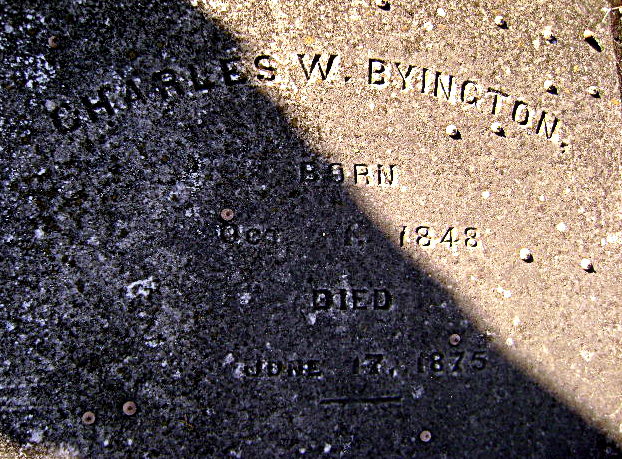
Charles was born 1 October 1848 and died 17 June 1875 "at his home in Fort Valley [Georgia]...after a long and protracted illness."

Image by James Allen.

It does not appear that Edward has an inscribed grave marker, but is possibly buried near his wife of fifty years.

Tampa Bay Times (St. Petersburg, Florida)
Monday, 7 March 1927 - pg. 2
Old Friends Mourn Death of Colonel E. T. Byington

By Jake Houston
Old friends of a generation that is almost forgotten are mourning the passing of Edward Telfair Byington, 73, who died at his home, 445 Second avenue south Saturday night, and who for 50 years has been identified with southern journalism.

Born in Albany Georgia, Colonel Byington, was a pioneer of the first large movement of population to Florida in the 90's. A year after the founding of Miami, 32 years ago, by Henry M. Flagler, found Col. Byington in this new resort as publisher of the News, which has since grown into the Miami Herald of today.

From that time till a few weeks before his death, Mr. Byington played an inspirational and responsible part in the rapid development of both east and west coast of Florida, through his editorial and special work for Miami publications, the Tampa Times, and Pinellas county newspapers, the St. Petersburg Times, the Tarpon Springs Leader, the Clearwater Sun, and the Evening Independent. Up until a few weeks before his death he was contributing editor on the Independent, writing anonymously, but with full command of his faculties and experience of more than 30 years of Florida progress.

His work brought him in contact with that first generation of Florida builders, Henry Flagler, of the Florida East Coast railway, whom he numbered among his friends; Henry M. Plant, of the west coast railroad development, and scores of others, who have passed on before him. He knew the story of the progress of Florida to 1925 probably better than any other man from his close association with the leaders of the movement.

His early newspaper success began with the Atlanta Journal, on which he served as city editor under John Paul Jones. He established in 1886 the Columbus Ledger, the first afternoon daily in that city, which he later sold. He served as editor of the Jacksonville Herald under the ownership of John Temple Graves and Henry Clarke, prior to his first venture in Miami, just after the completion of the railroad, when the place was no more than a small scattered grove center and hardly visioned health and winter resort.

Mr. Byington was the son of Caroline Jane McLendon, and James Lawrence Byington, old Georgia families. For many years he has been a member of the Christian Science church. Many of his friends knew his [sic] always as Colonel Byington -- the title echoing the days when his trenchant editorials on Georgia politics won his statewide recognition and a place on the staff of a Georgia governor of the 80's.

With Mrs. Byington, who was his active partner in many newspaper activities, and who survives him, Mr. Byington saw their 50th wedding anniversary pass on Jan. 17. They were married in Perry, Georgia. Two nieces, the Misses Lucy and Willie Collier of Tampa, also survive. Rhodes Funeral Co., is in charge of arrangements.

Interment will be in the family plot in beautiful Rose Hill Cemetery, Macon, Ga., Tuesday. Mrs. Byington, and Miss Lucy and Willie Collier will leave this morning to attend the last services in Macon.
Elia, wife of Edward, was a daughter of Charles T. and Cornelia (Warren) Goode, both of whom rest in Evergreen Cemetery at Perry, Houston County, Georgia.

Image by James Allen.


01 August 2021

Canadian Patrick W. McLaughlin Buried Away from Family in Macon, Georgia

Patrick William McLaughlin died at US Army (training) Camp Wheeler near Macon, Bibb County, Georgia less than a week before Christmas in 1917. He was a private in Company G, 124th Infantry, and cause of death was tuberculosis.

Augusta Chronicle (Georgia)
Friday, 21 December 1917
THREE MORE DEATHS AT CAMP WHEELER

Macon, Ga., Dec. 20. -- Patrick McLaughlin, of Company G, 124th Infantry, who died in the base hospital Tuesday night, is said to have seen service in the trenches in France in the present war. He was a Canadian. The body is still being held and efforts are being made to locate relatives...
That last line made me worry his family wasn't located in time, but then I found the following:

Atlanta Consitution (Georgia)
Sunday, 23 December 1917 - pg. 9
COMES FROM CANADA IN RACE WITH DEATH

Facing Zero Temperatures, Miss McLaughlin Arrives for Soldier Brother's Funeral.


Macon, Ga., December 22. -- (Special.) Miss Charlotte McLaughlin traveled all the way from Saskatoon, saskatchewan, in the Canadian northwest in response to a message that her brother, Patrick William McLaughlin, 24 years of age, was at the point of death at the base hospital at Camp Wheeler. She left Saskatoon on Monday morning while the temperature registered 45 degrees below zero and a heavy blanket of snow covered the ground, arriving here today.

Coming through the state of North Dakota on Wednesday Miss McLaughlin received a telegram that her brother was dead. She continued on to take charge of the burial, for Miss McLaughlin's parents are dead and the only other living member of the family is another brother, Bertrand Alexander McLaughlin, 21 years of age, who is a member of a Canadian artillery regiment mobilized at Kingston, Ontario.

Miss McLaughlin decided after her arrival to have her brother buried in Rose Hill cemetery in this city. Captain A. Wright Ellis, of Company G of the 124th Infantry, of which company her brother was a member, arranged for the service. All of the officers, including Captain Ellis and Lieutenants Giles, Simmons and Byrne, turned out yesterday morning for the funeral. The service was conducted by Captain L. A. Spencer, chaplain of the regiment. The funeral and burial were with full military honors and there was a large attendance at the service. There was an escort and a firing squad, the latter firing the usual salute at the grave.

This is the first soldier to be buried in Macon since the troops moved to Camp Wheeler and the base hospital was established there.

Miss McLaughlin left the city for her return trip tonight. She said that she had hoped, when she started out, to spend Christmas with her brother at Camp Wheeler.
(As an Amazon Associate I earn from qualifying purchases.)